
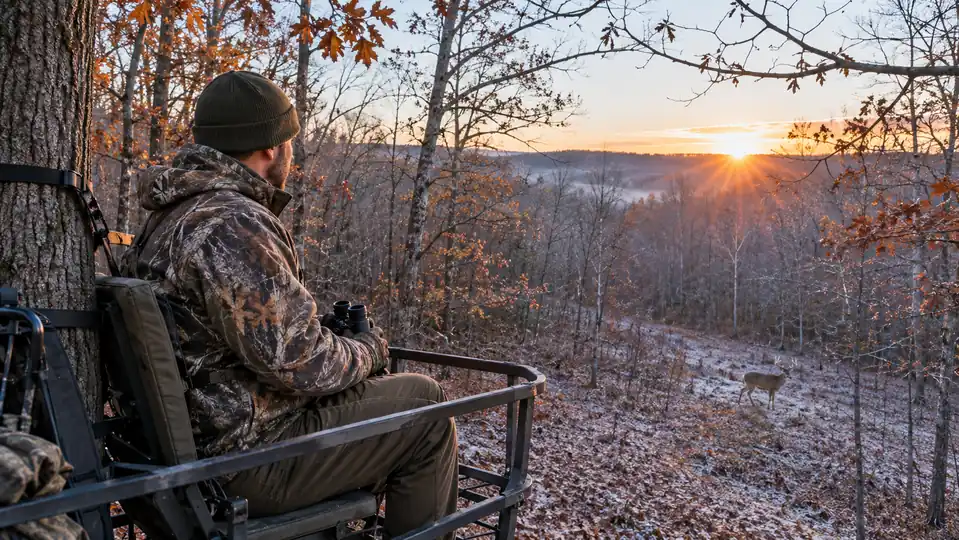
Twenty-two steps. That was my number for the oak at the edge of the hayfield, and I had been carrying it around in my head for the better part of a decade. Twenty-two steps, so call it eighteen yards, maybe twenty. I killed a doe off that estimate one October and felt lucky rather than skilled, which is a bad way to feel fifteen feet up a red oak. That winter I bought a rangefinder. The AOFAR HX-700N has been in my jacket pocket through a full Pennsylvania season since, archery in October and rifle in late November, and it has changed how I set up more than any other piece of gear I own.
Here is the short version of why that matters. A deer does not stand where you guessed. He stands three yards farther than you thought, behind a beech sapling, quartering away, and if you ranged the stump instead of the animal you are holding high or holding low and hoping. Estimating yardage works fine on a square target at a flat range. In the woods it is a coin flip you keep flipping until it comes up wrong. This is a small plastic and rubber device that hands you a real number in about a second, and after one season I trust it more than I trust my own eye. I did not expect to type that sentence.
The Quick Verdict
A 180 gram, IP54 rangefinder rated from 5 to 700 yards with six times magnification, a lithium battery in the box and 2 years of support. It is rated 4.5 stars across more than 11,000 marketplace reviews. Mine never gave me a number I doubted.
Amazon Check Today's Price →Stop guessing the distance. Start knowing it.
The AOFAR HX-700N weighs 180 grams, reads from 5 to 700 yards, and disappears into a coat pocket without pulling your vest sideways. Mine has been in the pack since the October opener.
Amazon Check Today's Price on Amazon →How I've Used It
I hunt a 60 acre wood lot that belonged to my father, plus whatever state game land I feel like walking. The wood lot has a ladder stand on the north edge and a hang-on stand I hung about fifteen feet up a red oak on the south side, where deer filter through a saddle before dark. That saddle is the reason I bought a rangefinder in the first place. Distances lie to you in there. The ground rolls, the light goes flat in the last twenty minutes, and a deer at what looks like thirty yards is often forty. I have the miss to prove it.
The HX-700N lived in the chest pocket of my jacket from the archery opener through the rifle season. I ranged the same six or seven landmarks every sit, quietly, before the light got good. A blowdown, a stump, a fence post, the near edge of the saddle, a rock the size of a cooler. Then when a deer showed up I only had to range one thing, the animal, and compare it to the numbers I already had. That is the whole method and it takes about ninety seconds at the start of each sit. It is the single most useful habit I picked up this year.
Let me give you the specific that made me a believer. Second Saturday of the archery season, a doe came down the saddle trail at what I would have called thirty-two yards by eye. I ranged her at twenty-six. Six yards is the difference between a clean shot and a deer that walks off to be found two days later, and I have made that mistake before and thought about it for a long time afterward. I settled the pin where the number said. She went down inside forty yards. I have killed enough deer that one of them does not move me much anymore, but that one did, because I knew exactly why it worked and it was not because I am a good judge of distance.
By mid November I had pressed that button maybe two hundred times. It never fogged on me in the cold. It survived a drop out of the hang-on stand onto frozen ground, which is the kind of test I do not plan and would rather not repeat, and it read fine afterward. My son-in-law Danny borrowed it for a morning, handed it back, and asked what it ran. That is the closest thing to a review I know how to give.
What the 700 Yard Rating Actually Means
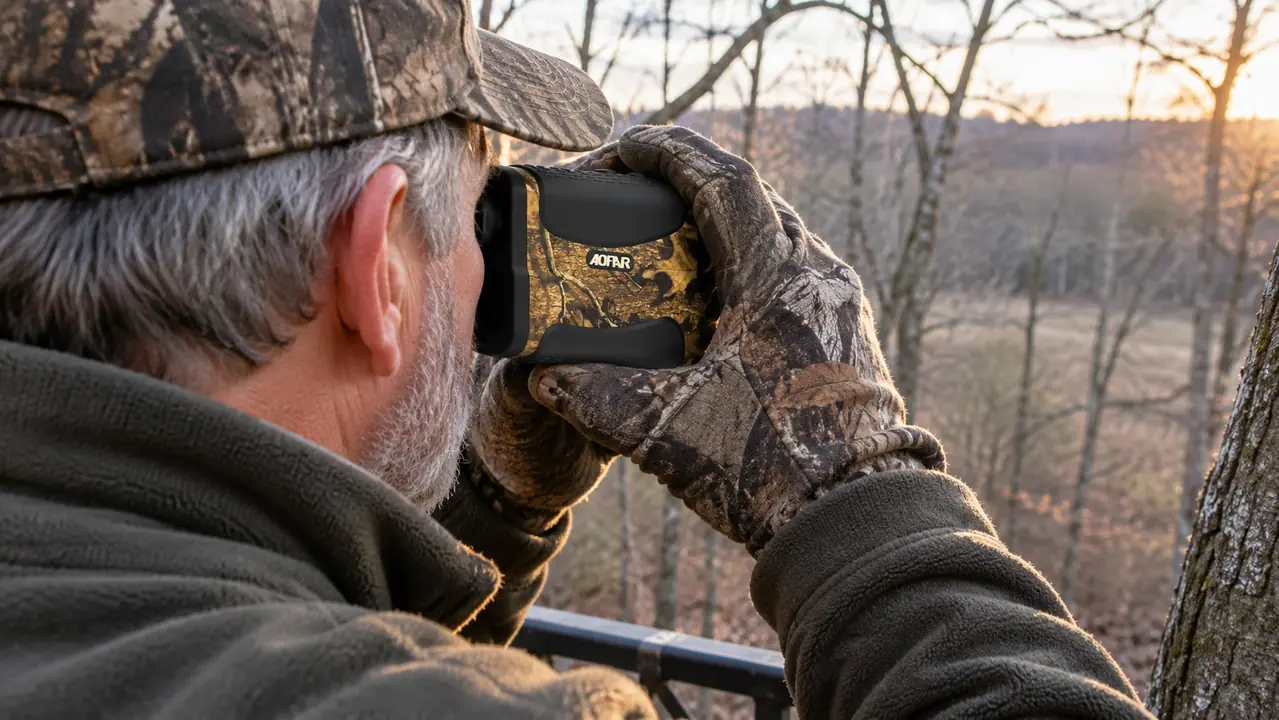
The listing says 5 to 700 yards, and the honest reading of that is a number off a large reflective target on a clear day, not a deer shoulder in heavy timber. What I can tell you is what I asked of it. Every shot I take from a stand sits between eight and sixty yards, and inside that window the thing is instant. Press the button, hold steady, get a number. I ranged a rock at 212 yards across the open field just to see, and it read it without argument. Whether it reads a barn side at 700 I have no use for and have not tested.
Here is how I checked it against something I could trust. Before the season I paced off twenty, thirty and forty yards on flat ground behind the shop and drove a survey stake at each one, then ranged them from the stake back to my boot. It read twenty, thirty and forty, no argument. Then I walked out to the far fence line, which I have mowed for thirty years and would have sworn was a hundred and ten yards from the gate. It read a hundred and thirty-one. I paced it twice to be sure and the device was right both times. That is a humbling thing to learn about your own eye at fifty-eight years old.
It is six times magnification in a body that measures about 4.3 by 1.8 by 2.9 inches and weighs 180 grams. That is small enough for a shirt pocket and light enough that I forget which pocket it is in. I have carried binoculars that weighed four times as much and did less of what I actually needed on a November afternoon. If you are the kind of hunter who packs a frame pack and a spotting scope, this will feel like a toy. If you are the kind who wants one less thing to think about, it is about right.
The body is plastic and rubber, and it feels like what it is, which is a tool and not an instrument. The rubber helps in cold weather and with gloves on. I wore work gloves for thirty some years as a lineman and I can find the button on this without looking, which after a season is the only ergonomics question that matters to me. A rangefinder you have to fish for is a rangefinder you stop carrying.
Cold, Rain, and a November That Did Not Cooperate
Potter County in late November is not a kind place to electronics. I hunted mornings that started at nineteen degrees and warmed to maybe thirty, and afternoons where the rain came sideways hard enough that I pulled my collar up and questioned the whole enterprise. The rangefinder is rated IP54 and described as waterproof, which in plain terms means rain and splashes are fine and a dunk in the creek is not. I would not swim with it. I also did not baby it, and it kept reading.
One morning in particular sticks with me. Third week of rifle season, fourteen degrees when I climbed, and the zipper on my jacket pocket froze hard enough that I had to work it with a thumb for the better part of a minute to get it open. When the rangefinder finally came out it read the stump at forty-one yards on the first press. The glass had not fogged and the button had not stiffened up. I put it back, worked the zipper with my glove off the second time, and sat until nine without seeing anything worth shooting. That is most mornings, and the gear still has to work on them.
The battery is a lithium cell and the unit ships with one in the box, which meant I was not tearing the kitchen drawer apart the night before the opener. I swapped it once at mid season out of caution rather than necessity. There is not much worse than a piece of gear that will not wake up in the last ten minutes of light, and I would rather spend a battery than find out.
The carrying case that comes with it is a small nylon pouch that loops onto a belt or a pack strap. I used it for about two weeks and then quit, because a pouch on a belt is one more zipper to open quietly when a deer is already inside your range. Mine rides loose in the jacket pocket now. That is not a knock on the case. It is a knock on me and on the way I hunt.
The Two Modes, and Which One I Actually Use
The AOFAR HX-700N has two basic modes, Range and Speed. I have used Range several hundred times and Speed exactly once, out of curiosity. Speed mode reads a moving object. It is a feature built for people measuring something in motion, and if you are a bowhunter waiting on a deer to take two more steps it is not a thing you will touch. I am not going to pretend I found a use for it, because I did not.
Range mode is the whole product as far as I am concerned. Press the button once, get a distance. It works off a tree trunk, off brush, off the ground in front of a deer, off the deer. The listing credits the unit with a pin sensor behind the lens, and I cannot tell you what happens inside that housing. What I can tell you is that the number it handed back matched a taped 20, 30 and 40 yards on a flat range, which is the only calibration I know how to do honestly.
Speed mode aside, the thing I appreciate most is that there is nothing to set up. I did not read a manual past the page that shows which button does what. There is no menu to get lost in at four in the afternoon when your hands are cold and the light is going. I have owned electronics that wanted to be configured before they would behave, and I have parted company with one of them. The AOFAR does not ask anything of you but a steady hand and a battery that is not dead.
One habit is worth building before you ever carry it into the woods. Range the animal, not the dirt at its feet, when you have the chance. Ranging the ground is still better than guessing, but a deer standing on a rise is a couple of yards different from the dirt below him, and a couple of yards matters when you are settling a pin on a quartering animal. Range the landmarks before light and the deer when he arrives, and you will skip the mistake I made for years.
I pressed that button maybe two hundred times this season. It never gave me a number I doubted, and it never fogged in the cold.
What It Won't Do
It will not make you a better shot. It will not tell you which pin to hold and it will not read the wind for you. It gives you a distance and you do the rest of it, and the rest of it is most of the job. I say that plainly because I have watched people buy a rangefinder and expect the deer to get easier, and the deer does not get easier. What gets easier is the decision, and only the decision.
There is a durability ceiling too. IP54 is a rating, not a promise, and I would not leave this on a truck dash in July or at the bottom of a wet pack liner for a week. It also is not a replacement for a decent set of binoculars if you glass before you commit. It is one job done well, and after enough seasons of gear that tries to do four jobs badly, I have come around to preferring that.
What I Liked
- Reads 5 to 700 yards and hands back a real number in about a second, which ended years of estimating for me
- 180 grams and roughly 4.3 by 1.8 by 2.9 inches, so it vanishes into a jacket pocket
- Six times magnification is enough to pick an animal out of timber in flat last light
- IP54 rated and waterproof enough for sideways rain, snow and a drop onto frozen ground
- Ships with a lithium battery, a carrying case and 2 years of VIP support
Where It Falls Short
- Speed mode is dead weight for a whitetail hunter, and I will not pretend otherwise
- IP54 covers rain and splashes, not a dunk in the creek
- Plastic and rubber body feels like a tool rather than an instrument
- The belt pouch takes two hands to open quietly, so mine rides loose in a pocket
Who This Is For
The bowhunter who hunts the same stands year after year and keeps guessing the same distances. The rifle hunter working broken ground where a twenty yard mistake is a miss or worse. The person who wants one small tool that reads a number and does not need a phone, a charging cable or a firmware update to do it. If you hang stands in October and hunt them until the snow flies, this belongs in your jacket pocket, and it will probably stay there.
Who Should Skip It
If you hunt flat farm ground where every shot is a known eighty yards, you already know your numbers and this will live in a drawer. If you glass wide open country and need to range past 700, buy something built for that instead. And if you want a device that does the arithmetic for you, this is not that device. It gives you a distance and you decide what to do with it, which is how I like it and not how everybody does.
One season. Two hundred ranges. Zero numbers I argued with.
180 grams, 5 to 700 yards, six times magnification, IP54, and a lithium battery in the box. Read the marketplace reviews yourself, then make the call before your season starts.
Amazon Check Today's Price on Amazon →