

Short answer: the AOFAR HX-700N does not make you a better hunter. It gives you a number where you used to have a hunch, and a number is a thing you can plan around. Guessing yardage is free, weighs nothing, and never dies in the cold, which is why I did it for the better part of thirty seasons. I killed deer that way and I am not going to pretend otherwise. I also missed a buck I would have sworn was thirty yards and later stepped off at forty two, and that miss is why there is a rangefinder in my pack today. The device did not fix my shooting. It fixed my arithmetic.
So this is less a product comparison than a comparison between a tool and a habit. One column is a 180 gram device with 6x magnification and a measuring range of 5 to 700 yards. The other column is your eye, your memory of a particular tree line, and whatever number you talked yourself into at full draw. Both of them have real advantages, and I am going to give the habit its due, because after forty seasons I have watched guessing work more often than any gear writer wants to admit.
| AOFAR HX-700N | Guessing Yardage | |
|---|---|---|
| Reading an unknown distance | Returns a number from 5 to 700 yards on whatever you point it at | Eye and memory, close on flat ground, further off across a hillside or a clear cut |
| Repeatability | Same tree, same number, every time you try it | Roughly right most days, worse when you are tired or hurried |
| Speed to the shot | One more thing to raise, aim and read before you draw | Nothing to raise. Your shoulder never leaves the stock |
| Weight and bulk | 180 grams, about 4.3 by 1.8 by 2.9 inches, in a jacket pocket or a pack lid | Nothing to carry, nothing to leave on the tailgate |
| Batteries | Runs on a lithium cell, and the cell will quit on you eventually | Never dies, never needs a spare in the glove box |
| Getting started | One purchase, then an evening of practice on stumps and fence posts | Free, and you have been doing it since you were a kid |
| Rain, fog and flat light | Rated IP54 and listed as waterproof, with a listing claim for harsh conditions | Works in the rain, reads worse in flat light when the depth cues go away |
| Settling an argument with a new hunter | You range the stump and both of you see the same number | Two people, two guesses, and nothing to settle it |
| Learning curve | Two modes and a short walk through the manual | None at all |
What the HX-700N Actually Does
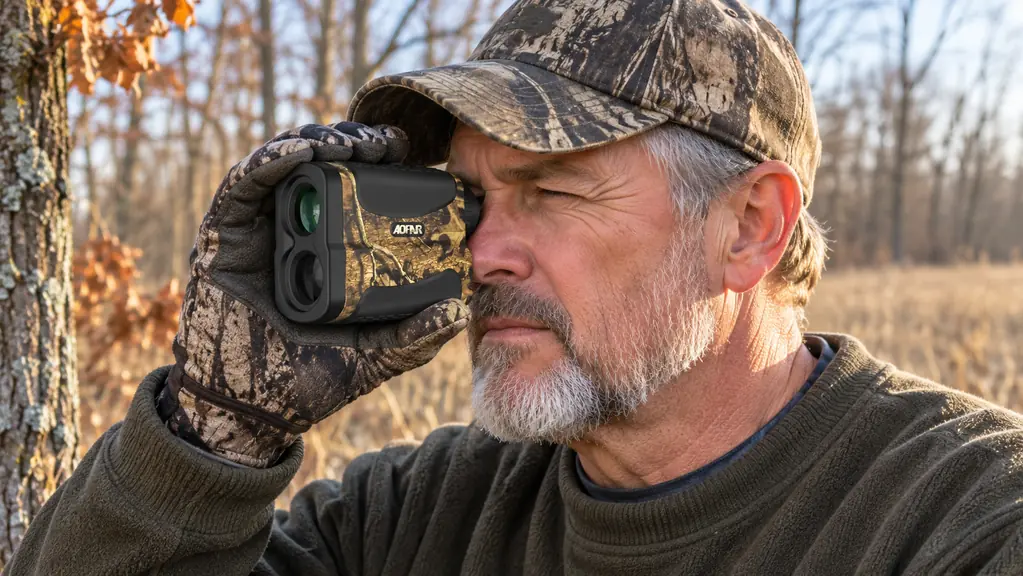
The HX-700N is a small 6x rangefinder with a measuring range of 5 to 700 yards. That is the whole pitch. You point it at something, you take a reading, and a distance comes back. It runs in two modes, Range and Speed. Range is the one a hunter uses. Speed is for moving targets, and I have used it more out of curiosity than out of need, though it is there if you want it. AOFAR builds the unit around what they call pin sensor technology, which is their name for the sensor setup behind those readings.
In the hand it is 180 grams, roughly 4.3 inches long, 1.8 wide and 2.9 tall, and the body is plastic with rubber in the places your fingers land. That rubber matters more than it sounds. A rangefinder that slides out of a cold hand onto a rock is a paperweight. Mine rides in a jacket pocket or the lid of my pack, and the carrying case that comes with it is where it lives in the off season. Water resistance is rated IP54 and the listing calls the unit waterproof. I have used it in wet snow and light rain without trouble, and I dry it off at the end of the day like I do with everything else in the pack.
Practice is the part nobody mentions. The evening mine arrived I stood in the driveway and ranged the barn wall, the mailbox post and a stump at the edge of the field, then walked each one off with a tape and a step count to see if the numbers were honest. The barn came back within a yard of the tape. The stump matched. What surprised me was how long it took my eye to catch up to what the screen kept saying. Reading a number is instant. Believing it took most of an evening.
What it does not do is solve your drop for you. It gives you a distance. You still have to know what your bow or your rifle does with that distance, and you still have to hold steady when the moment comes. There is no app to pair, no menu tree to learn, no update to chase. There is a lithium battery in the box, a case, and a two year VIP support promise from AOFAR. That is the offer, and for a tool that answers one question, it is enough.
Where the AOFAR HX-700N Wins
The rangefinder wins anywhere you do not already know the distance by heart. A clear cut, a new property, the far edge of a gas line right of way, a bean field you have only seen from the road. My eye is decent to about 25 yards on flat ground and starts drifting past that. It drifts worse when I am excited, which is exactly when it matters most. The difference between 30 and 40 yards with a bow is the difference between a pin and a prayer. The HX-700N settles that in a second, and it settles it before you draw instead of after.
The other thing it does is let two people agree. My son in law Danny started hunting about six years ago, and early on we would stand at the edge of the wood lot and disagree by ten yards about the same stump. That argument is over. I range the stump, he reads the number over my shoulder, and we move on to something else. Before the season I range the landmarks around both stands, the big oak, the fence post at the corner, the rock in the lane, and I write the numbers on a card that lives in my jacket pocket. When a deer steps out I already know the distance before anything gets raised.
Rifle season makes the case differently. On the gas line right of way I can see a long way, and there are stretches where the deer looks closer than it is because there is nothing between you and it to give your eye a reference. I have ranged a doe at what felt like 180 yards and had it come back at 260. That is not a rounding error. That is two different holds and, on the wrong day, a wounding shot. The 700 yard ceiling on the HX-700N is more than I will ever need on the wood lot, but having room past 300 is what makes it useful in open country.
It also keeps me honest about my own limit. There is a stretch of the lane where I used to talk myself into a shot because the deer looked closer than it was. Now I know it is 44 yards from that stand to that stump, and I know what I can do at 44 yards, and it is not enough. Knowing the real number sometimes means passing. That is a gain, not a loss.
Where Guessing Yardage Wins
Now the other column, because it earns its place. Guessing is free, and I mean that plainly. There is nothing to buy, nothing to charge, nothing to leave sitting on the tailgate when you pull away. It weighs nothing and it cannot fog up. In the woods I actually hunt, thick second growth on the wood lot and oak ridges on the state game lands, most of the shots I have taken with a bow have been inside 30 yards. At that range a hunter who practices has a good eye, and a rangefinder does not change the outcome much. I have killed plenty of deer without one, and I am not going to pretend those mornings were incomplete.
Practically speaking, half the stands I sit in do not even offer a 30 yard shot. The hang on stand in the hemlocks has one shooting lane and it is 19 steps from the trunk to the edge of the brush. There is no number to get wrong there. My father hunted that same patch for decades with a rifle and a red hat and never once wished for a battery. When the cover does the work for you, the tool is solving a problem that does not exist on that ground.
Guessing is also faster. Raising a rangefinder is movement, and movement at 20 yards is the thing that ends a hunt before it starts. There are setups where I will not lift anything, where the deer is close and quartering and the number in my head is good enough. A dead battery has ruined more of my mornings than bad math ever did. The catch is that the habit fails quietly. You get no warning when your eye is ten yards off. You get a clean miss and a story about how the deer ducked the arrow.
Know the number before you draw, not after
The HX-700N reads from 5 to 700 yards, weighs 180 grams, and runs on the battery that comes in the box. One less thing to argue with yourself about when a deer steps into the lane.
Amazon See the AOFAR HX-700N on Amazon →
The Morning the Math Went Wrong
Two seasons back I was in the ladder stand on the back side of the wood lot, on a cold morning with a light crust on the snow. A buck came down the lane from the north and stopped behind a blowdown. I had hunted that lane for years and I knew it was 30 yards. I knew it the way you know your own driveway. I drew, and I shot over him. When I climbed down and walked it off, the blowdown was 42 steps from the base of the stand. Not 30. Forty two. I had been telling myself a story about that lane for a decade, and the story was wrong.
I bought the AOFAR that summer, more out of irritation than wisdom. The first thing I did was walk the whole lane with it and write down numbers. The blowdown was 41 yards from the stand, close to my step count. The fence post at the corner was 26. The big oak on the left was 63. I had been wrong about all three by between four and twelve yards, and I had been confident about all three. That is the part that sat with me. Not the miss. The confidence.
I found the arrow about 60 yards past where the buck had stood, buried in the crust and easy to spot once the sun came up. No blood on it, no hair, nothing. I looked for sign for the better part of an hour anyway, because that is what you do, and then I walked back to the truck and sat in it with the heater running for a while. There is no version of that morning where a rangefinder would have made me a better archer. There is a version where it would have kept me from taking the shot at all, and I would have taken that trade.
The rangefinder never told me I was a bad shot. It told me I was a bad estimator, which is a much easier thing to fix.
Who Should Buy Which
Buy the AOFAR HX-700N if you hunt ground you do not know cold, if you hunt with a bow and your pins start past 25 yards, if you have a newer hunter with you and you are tired of arguing about distance, or if you have ever walked off a shot and found the number was not what you thought. That last one covers most of us eventually. It is also the right tool for a rifle hunter on a pipeline or a bean field, where the gap between 250 and 300 is real and your eye is worthless.
Keep guessing if every shot you take is inside 25 yards in thick cover, if you have a good eye and you have proven it on paper, and if you know in your gut that you will not carry one more thing into the woods. That is a legitimate choice and plenty of good hunters make it. What I would ask is that you test the eye instead of trusting it. Step off distances on the ground you hunt, then check yourself against them. Most people find out their eye is fine close and drifts past 30, which is exactly where a bow gets unforgiving.
The middle ground is what I actually do. The rangefinder stays in the pack and comes out before the season, and again whenever the setup is new. During the season, on the stands I know, I have already ranged the landmarks and written them down, so the unit stays where it is. It is not a device you have to be fiddling with in the dark. It is a device that answers a question you should not be answering by feel.
Range your landmarks once, hunt the rest of the season knowing the numbers
6x magnification, 5 to 700 yards of measuring range, 180 grams, with the battery and the carrying case in the box. Two year AOFAR support standing behind it.
Amazon Check Availability on Amazon →