
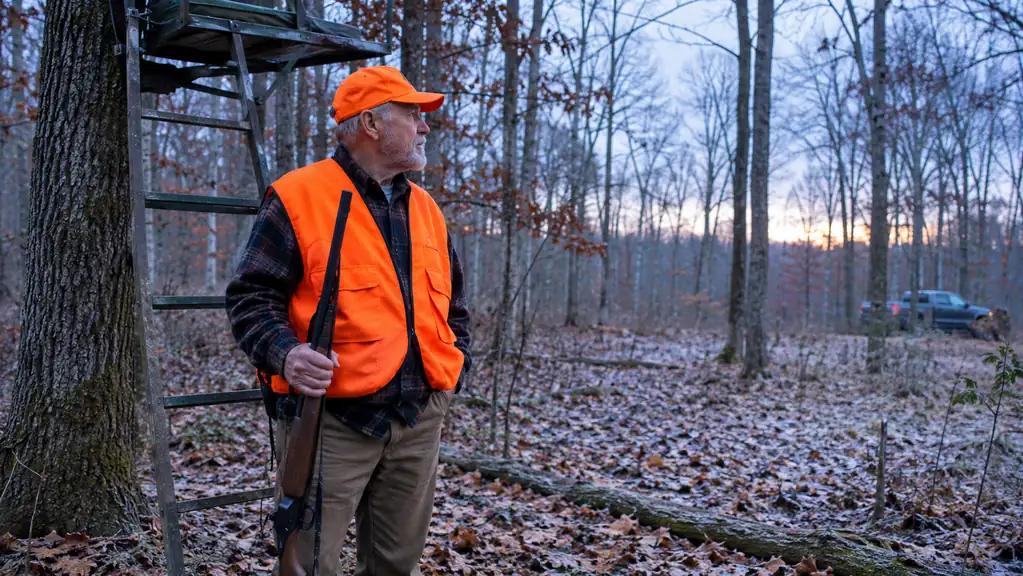
Every treestand accident I've heard about in Potter County started with a man who already owned a harness. It was in the truck. Or in the pack. Or it was on his body but the tether was clipped to a loop it shouldn't have been. That's the part that doesn't get said out loud: almost nobody gets hurt because they never bought the gear. They get hurt in the ten seconds between the ground and the first rung, when the harness is still hanging on a branch.
I've hunted about 40 seasons, most of them out of a ladder stand and a hang-on on my father's 60-acre wood lot outside Coudersport. I wear a Hunter Safety System X-1 Bow-Hunter harness in small/medium, and I've worn it long enough that the order of the buckles is muscle memory now. But the harness itself is maybe a third of the job. The rest is the sequence you follow and the checks you make without thinking about them.
Below is the order I do it in, from the tailgate to the walk back out. It applies whether you're in a ladder stand on private ground or a hang-on two miles in on state game lands. None of it is complicated. All of it has to be habit, because the one morning you decide it isn't worth the trouble is the one morning it matters.
A harness does nothing while it's hanging on a branch
The Hunter Safety System X-1 goes on over your jacket at the truck, not at the base of the tree. Small/Medium carries a maximum weight capacity of 175 pounds, so check the sizing before you order.
Amazon Check Today's Price on Amazon →Step 1: Inspect the harness before the season, in good light
Take it out in August. Lay it flat on the tailgate of the truck and go over it the way I used to check a hot stick before it went up a pole: webbing first, then stitching, then hardware. Ten minutes, once a year, in daylight, with the reading glasses on and the gloves off.
Look for fuzzing, flat spots, sun-faded runs, and any cut deeper than the surface. The Hunter Safety System X-1 is a lightweight polyester blend with EVA and neoprene in it, and at 2 pounds it folds up small enough to live behind a truck seat, which is exactly how webbing gets damaged. Nine months wadded up in a cab is harder on it than a full season in the woods.
Then the buckles for cracks, and the stitching at every point that takes load. If something looks questionable, retire it. A harness is not a piece of gear you nurse along or patch in the garage. The care instructions call for hand wash only, and that's the right instinct for the whole item: rinse it, dry it out of direct sun, store it loose.
I use the same rule on a harness that I use on climbing rope. If I can't remember when I bought it, it's older than I think it is. Sun and sweat break webbing down quietly, and a harness that looks fine on the outside can have stitching that's been cooked in a truck cab for four summers.
Step 2: Fit it on the ground, over the layers you actually hunt in
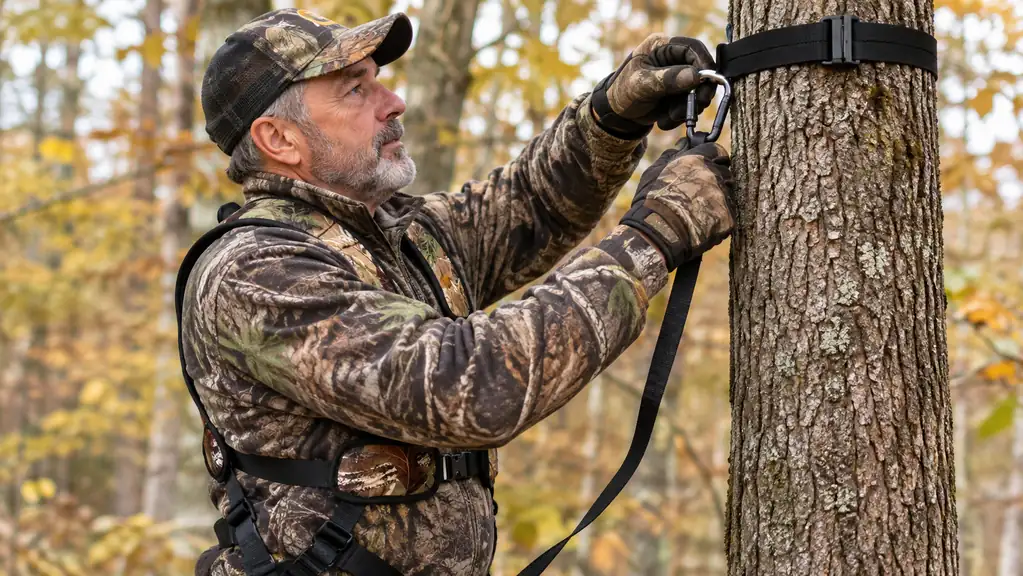
For years I fit my harness in the driveway in September wearing a t-shirt, then spent November fighting it over a base layer, a fleece, and a parka. The straps end up somewhere new, the leg straps sit too low, and you climb the tree tugging at yourself the whole way up.
Do it in late-season clothes instead. Shoulders snug. Leg straps tight enough that you can't slide a fist under them. Chest strap set high enough that it doesn't ride into your throat when you sit down. The Hunter Safety System X-1 is a slim fit, which is the point of a bowhunting harness, but slim only helps if you fit it dressed the way you'll be dressed in the cold.
One thing to check before you order. Small/medium is rated to a maximum weight capacity of 175 pounds on the listing. If you're above that, or close to it once you're in late-season layers, move up a size. That number is about the harness, not about you, and there's no prize for squeezing into the wrong one.
Gloves belong in this step too. Fit the harness at home wearing the gloves you'll actually hunt in, because a buckle that's easy bare-handed is a different job in a liner and a mitten. If you can't work the buckles with cold hands, you'll skip steps at the base of the tree. That's how this goes wrong.
Step 3: Set the tree strap above head height and keep the slack short
The tree strap decides whether a slip is a story you tell or a ride to the hospital. Set it around the trunk so the attachment point is at or above head height while you're standing on the platform. Set it at chest level and you'll fold over it in a fall. Set it so high that the tether hangs loose and you'll drop a ways before anything catches you.
Then test the slack with your own hands. I wrap the strap, clip in, and lean back to feel where it stops me. If I can drop several inches before it loads, it's too loose and I reset it. The X-1 ships with a tree strap in the box, so this isn't extra gear you have to go buy.
Set it before you step onto the platform. Not after you're settled with the bow on a hook and your pack open and your release on your wrist. The strap gets set first, every time, on the way up.
Wind is part of this step, not a separate subject. On a gusty day the tether takes a load you didn't plan for, because the tree moves and you don't. Sit down after you set the strap and pay attention to how the rig feels when the trunk sways. If it's pulling you off balance, hunt lower or take the ground blind instead. There's no shame in the blind.
Step 4: Clip in before your boots leave the ground and stay clipped while you sit
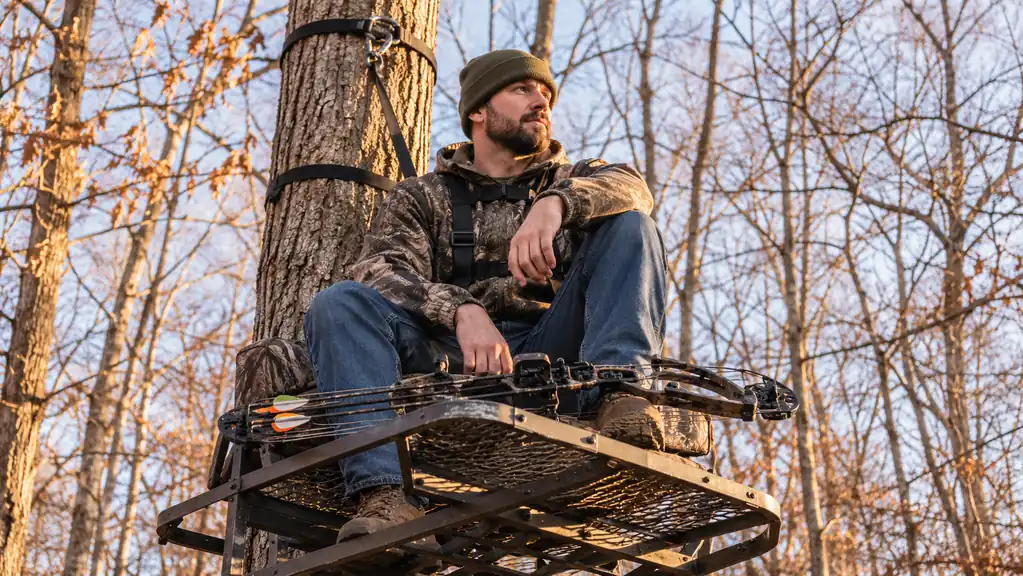
Plenty of men clip in once they're seated. That's backwards, and it's the hole in the whole plan. Falls happen on the way up, on the way down, and in the two seconds when a man turns around to sit. If you aren't attached for those, the harness is decoration.
On the ladder stand I'm attached before the third rung. On the hang-on, which I climb with sticks, the rule is the same at the bottom of the tree instead of near the top. If the stand has a lifeline rope, the prussic goes on before I start climbing and slides up with me, so there's never a stretch of the climb where I'm loose.
And once seated, the tether stays on. I've heard the argument that it gets in the way when a deer steps out, and I understand the temptation. The Hunter Safety System X-1 is cut for bowhunters, and with the tether set right there's very little difference between a shot taken clipped in and one taken without. Practice it in the yard a dozen times in the off-season and the awkwardness goes away.
Coming down is the other half nobody talks about. I unclip nothing until both boots are on the ground. Not at the last rung, not at the platform. There's a reason for that. Tired legs at the end of a long sit are exactly when a man gets sloppy, and if you're already detached, a rolled ankle on the last three feet of a ladder turns into a fall.
Step 5: Carry the suspension relief strap where you can reach it and know how to use it
The X-1 includes a suspension relief strap, and the reason it exists is that the fall is usually not what kills a treestand hunter. Hanging is. Legs dangling with the weight of your body on two straps, no way to unload it, and blood starts pooling. A man goes light-headed in a matter of minutes and stops thinking clearly after that.
So the strap rides on your body, not in a pack at the base of the tree. Loop it where it needs to go, put a boot in the bottom of it, and stand up to take the pressure off your legs. It buys minutes. Minutes are what you need to work out how you're getting down.
Practice the hang once, low and slow, in the yard. Set the stand at knee height, clip in, and work the suspension relief strap until your boot goes in without looking. It takes five minutes, and it's the difference between a plan and a hope. Nobody wants to learn that strap for the first time hanging fifteen feet up.
The other half of that is a plan. Someone on the outside needs to know which tree you're in and when you should be back at the truck. My son-in-law Danny gets a text with the stand location every time I go out, and if I don't answer at an agreed time he comes looking. That's not nerves. It's just how you do it once you've been at this long enough.
The fall is usually not what kills a treestand hunter. Hanging there with your legs dangling is.
What Else Helps
A lineman belt is worth understanding even if you don't own one yet. It wraps the tree and lets you lean back with both hands free while you hang sticks or set a stand, and it makes the climb itself safer rather than only the sit. If you're setting stands alone, that's the piece that changes how the job feels.
A lifeline rope on any stand that stays up is the other upgrade I'd make. Fixed rope from the ground to above head height, prussic knot that slides as you climb. You end up attached for the whole ascent instead of only at the top, which is where most of the trouble happens.
Smaller things, but they add up. Haul the bow up on a rope instead of carrying it over your shoulder on the ladder. Keep the phone in a chest pocket, not in a daypack you'd have to take off. Tell somebody the plan, even when the plan is a two-hour sit after work. And read the wind forecast, because a stand that's fine at ten miles an hour is a different animal at twenty-five.
One more thing that isn't gear. Hunt with somebody, or at least tell somebody. Danny and I split up on the wood lot, but we both know which stand the other one is in. That's the whole system, and it has never once cost me a deer.
None of this is expensive in time. The inspection is ten minutes in August. The fitting is five minutes in the driveway. The rest is deciding, once, that the harness goes on at the truck and comes off at the truck, and then never renegotiating it with yourself at the base of a tree in the dark.
When you add it up, the harness is the simplest part of the whole thing. It's the order of operations around it that keeps a man out of the hospital, and the order of operations costs nothing but a little discipline at the tailgate.
Put it on at the truck, not at the base of the tree
The Hunter Safety System X-1 weighs 2 pounds, ships with a tree strap and a suspension relief strap, and fits over late-season layers. Check the 175-pound rating on the small/medium before you order.
Amazon Check Today's Price on Amazon →