
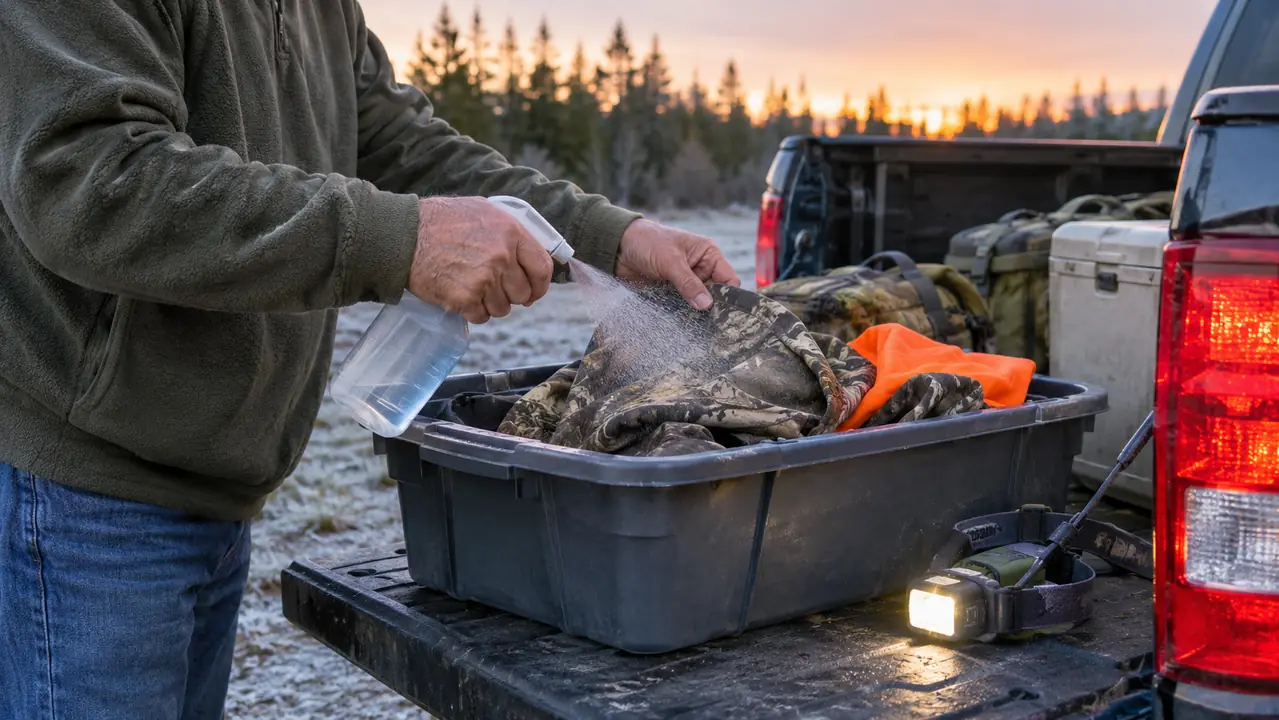
Two seasons back my son-in-law Danny stood at the tailgate of my 2011 F-150 with a plastic tote of camo in his arms and asked me a fair question. If he washes his hunting clothes in scent-free detergent, does he still need to spray down with Wildlife Scent Killer before he walks in? I told him the spray mattered more. That was half right, and I have spent two seasons since then working out which half. The short version is that these two products do different jobs. One pulls odor out of the fabric. The other buys you time after you put the fabric on. Mix up the jobs and you spend money twice and still get blown at.
If you are only going to do one, wash the clothes. Scent-free detergent is the part you cannot work around, because human sweat and skin oil live down inside the fibers and no spray on earth lifts them back out. The Wildlife spray is the last hundred yards: your boots, your pack straps, the seat of the stand, the gloves you set down in the leaves while you glass. If you are already laundering your gear and still getting picked off on the walk in, the spray is probably the piece you are missing. If your hunting clothes have never been washed in anything but regular detergent with a dryer sheet, buy the detergent first and come back for the spray next season.
| Wildlife Scent Killer Spray | Scent-Free Detergent | |
|---|---|---|
| What it goes after | Human odor at the molecular level, per the label | Odor held in the fabric, plus the oils and sweat that feed it |
| Where you use it | Boots, gloves, pack, stand, release, blind fabric, and clothing | The washing machine only |
| How long it keeps working | Label cites Rutgers testing showing 99 percent effective ten days after drying | Until the garment picks up new sweat on the walk in |
| Setup effort | A few minutes of misting before each hunt, more on high contact gear | One load in the washer, then hang to dry |
| Actually cleans the fabric | No, it is not a cleaner and will not lift dirt or oils | Yes, that is exactly what it is built to do |
| Works on gear you cannot wash | Yes, boots, harness, pack, bow release | No |
| Published testing | Rutgers University testing cited on the label | Depends entirely on the brand, so read the bottle |
| Best for | Holding the line between the truck and the stand | Starting every hunt with a clean base layer |
Where the Wildlife Spray Wins
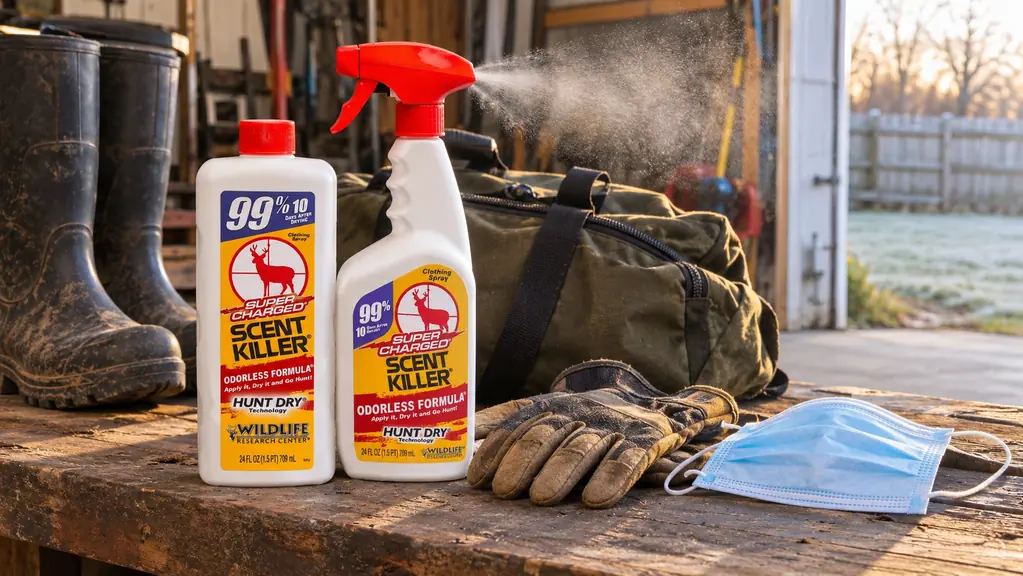
The spray earns its place on the gear you cannot put in a washer. Boots, rubber soles, the shoulder straps on a pack, a bow release, the rail of a ladder stand, the fabric on a ground blind, the cushion you sit on for four hours. None of that goes through a wash cycle and all of it touches the woods. A deer that cuts your track sixty yards before the stand is not smelling your shirt. It is smelling whatever walked there, and most days that is boots. Wildlife built this product to be applied and then left alone. The label cites testing at Rutgers University showing it 99 percent effective at stopping replicated human odor ten days after drying, which is a specific claim from an independent lab, and I will take a number like that over any adjective printed on the front of a bottle.
The second thing the spray does is cover the gap in time. Detergent works the night before. The spray works at the truck. Danny's early mistake was spraying his clothes at home on Friday and then riding to the wood lot with them in the truck bed next to a gas can, a bag of corn, and the boots he wore last week. He blamed the spray. I blamed the truck bed. Applied at the tailgate and left to dry while I load the pack, the spray is working during the exact window when I am sweating and breathing hard on the way up the hill. The 48 ounce combo is the format I buy, one 24 ounce field bottle and one 24 ounce refill, because I hunt enough days that a single small bottle runs dry in the middle of the season.
Where Scent-Free Detergent Wins
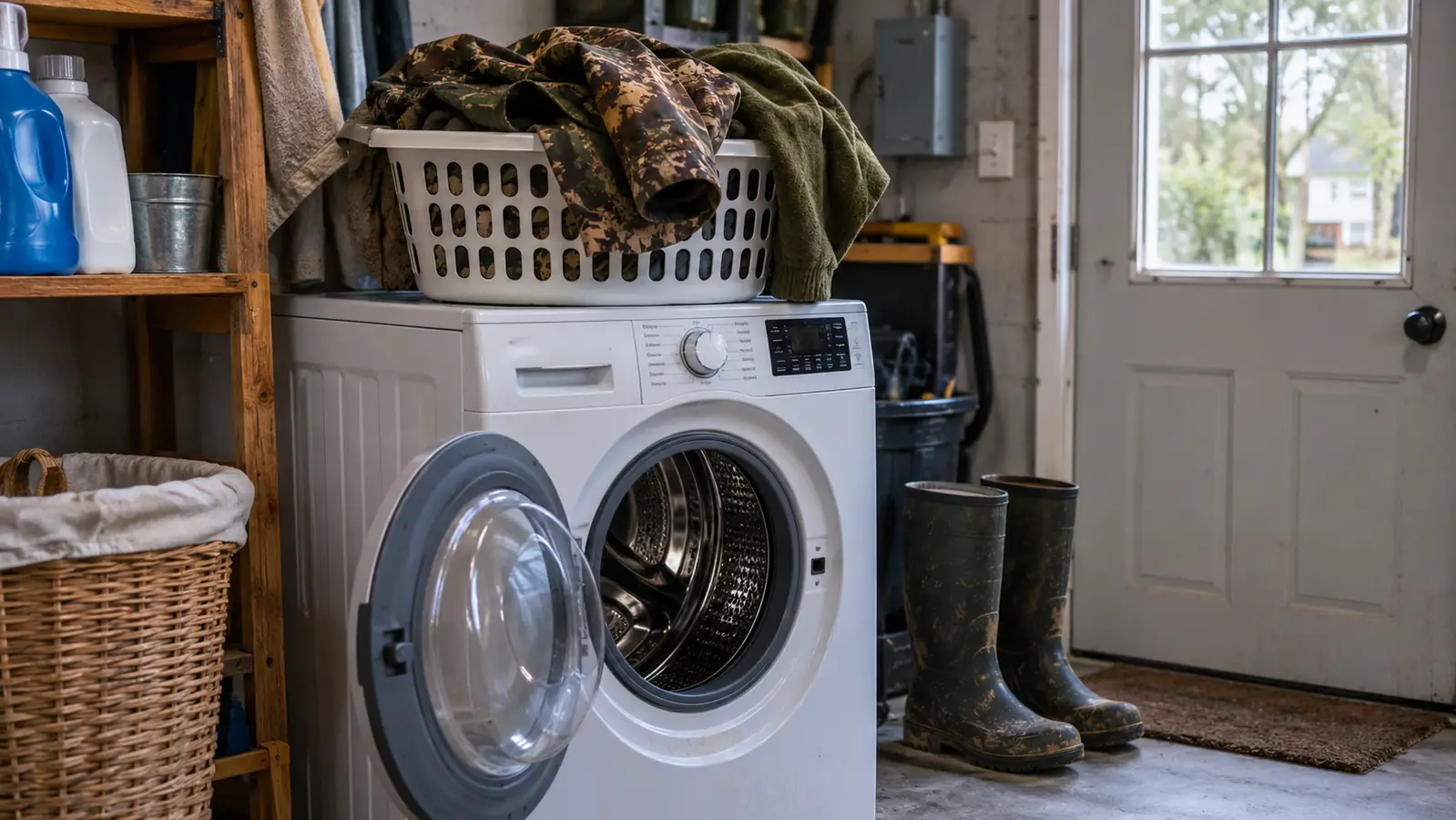
Detergent wins the part that matters most, which is cleaning. Human odor is not a mist that settles on your jacket. It is salt and oil and skin cells worked into the fabric, and it builds up over a season of sits. A spray sits on the surface. A wash lifts the residue out and carries it down the drain. If a base layer still smells like a locker room when it is clean and dry, spraying it is like putting deodorant on a dirty shirt. It does not fix anything, it just adds a layer on top of the problem. I have watched hunters spend real money on sprays and cover scents while washing the same shirt in the same scented detergent every week and running it through the dryer with a softener sheet. Then they wonder why a doe blows from the fence line. The washer was the problem the whole time.
Detergent also wins on effort and on how ordinary it is. It is one more load of laundry, and you already run laundry. There is no bottle to remember at the truck and nothing to reapply when you stop for coffee on the way out. For a man who hunts a handful of weekends a year, that matters more than a lab number. A clean base layer and a tote that stays closed is a complete scent routine for plenty of hunters, and it is honest to say so. The spray is not a substitute for that. It is an addition to it. Where the spray routinely loses is consistency. Guys buy the bottle, use it hard through October, and by the second week of rifle season it is rolling around under the seat half empty with the cap off.
The half of the routine a washer cannot reach
Boots, pack straps, the stand, the release. None of it goes in the wash and all of it touches the woods. The 48 ounce combo gives you a 24 ounce field bottle plus a 24 ounce refill to get through a season.
Amazon Check Today's Price on Amazon →How I Tested Both on the Wood Lot
I am not a lab and I am not going to pretend otherwise. I am a retired electrical lineman living outside Coudersport, and I hunt whitetails out of a ladder stand and a hang-on stand on my late father's sixty acre wood lot, plus some state game land when the pressure pushes me off it. What I did over two seasons was simple. I split my base layers into two totes. One set got washed in scent-free detergent and nothing else. The other got washed the same way and then sprayed at the tailgate before every sit. I rotated them on the same stands in the same wind and wrote down what I saw. That is the whole method. No control group, no lab coat, no claims I cannot back up.
Here is the honest result. On a good wind, a north wind in my face on the ridge stand, I got away with either one. I have had does feed inside twenty yards on days I was lazy and days I was careful, because the wind was right and the thermals were pulling downhill into the hollow. On a bad wind, neither product saved me. So the first thing to understand is that scent control is a stack of small advantages and the wind is still the biggest item in the stack. Nobody sells you the wind, and no bottle makes a bad setup into a good one.
The pattern I could actually see showed up on the walk in and on the mornings I sat the ground blind. When I went in with a clean base layer and sprayed boots, I got snorted at from behind less often, and I mean that literally, a deer blowing somewhere back down my track. When I skipped the spray and worked up a sweat on the climb in October, that snort came more often. Small sample, one hunter, no way to prove it. But it lines up with what both products claim and it takes no extra time to keep doing. Danny has run the same routine for four seasons now and swears he gets picked off less than he used to, for whatever a son-in-law's word is worth to you.
What the Spray Does and What It Does Not
How I run it, for what it is worth. Spray at the truck before I put the pack on, especially the boots, the outside of the pant legs, and the back of my gloves. Let it dry while I load up and check the bow or the rifle. Spray a second time at the base of the tree if it is warm and I sweated on the climb. The label's claim is that it keeps working after it dries, and Hunt-Dry is the name they give that technology, so I give it the time to dry instead of misting and walking straight in. Dry gear feels better on a cold morning anyway.
The 48 ounce combo is two bottles, a 24 ounce field spray and a 24 ounce refill, and the unit measures 2.5 by 7 by 10.88 inches, so it drops into the side pocket of my pack without a fight. That is the whole spec sheet that matters to me. It does not carry a scent I can pick up, which is the minimum you should expect from something in this category, and it does not leave a wet mark once it dries. I keep the refill in the tote in the garage and top the field bottle off at the start of every season so I am not the guy with an empty bottle on opening morning.
What it will not do is clean your clothes. It will not lift the salts out of a base layer you have worn for three sits in a row. It will not fix a wind that is pulling your scent straight into the hollow you are watching. It will not help if you leave it in a hot truck for a month, and it will not do anything for the inside of a boot you have worn for six seasons without ever washing the liner. It is one specific tool for one specific job, and the job is the last hundred yards between the truck and the stand.
What I Liked
- Reaches boots, packs, stands and releases that never see a washer
- Label cites Rutgers testing at 99 percent effectiveness ten days after drying
- 48 ounce combo includes a 24 ounce field bottle and a 24 ounce refill
- No scent of its own that I can detect, and it dries without a wet mark
Where It Falls Short
- Does not clean fabric, so it is useless on unwashed clothing
- Needs consistent reapplication on boots and gloves
- Will not rescue a bad wind or a sloppy approach
- One more bottle to remember at five in the morning
The detergent takes the odor out of the fabric. The spray buys you time after you put the fabric on. Expecting one to do the other is how a season gets wasted.
The Detergent Mistakes That Cancel It Out
The most common way hunters cancel out good detergent is by using too much of it. Modern machines and high efficiency detergents do not need a full cap, and leftover soap stays in the fibers and holds odor the same way sweat does. Use the amount on the bottle, or less if your water is soft. The second way is the dryer sheet. Fabric softener and dryer sheets coat the fabric with a scented film, which is the exact thing you paid to avoid. Hang the clothes to dry, on a line in the garage or over the porch rail, and do not run them through the dryer with anything scented, including a towel.
Storage undoes a lot of good washing too. Clean clothes go into a clean tote that stays closed, not into the same tote where the boots live. I keep two, one for clean and one for everything else, and I spray gear at the truck rather than in the garage so whatever I used last is not floating around the clean clothes overnight. None of this is difficult. It is just easy to skip when you are loading up at five in the morning with a thermos in one hand and a headlamp in the other, which is exactly when it gets skipped.
Who Should Buy Which
Buy the detergent first if you are new to this or if your hunting clothes have never been washed in anything scent free. It is the foundation and it asks almost nothing of you. Buy the Wildlife spray if you already launder your gear properly and still get snorted at from behind on the walk in, or if you hunt a ground blind where you sit on the same cushion for hours, or if you have gear that never sees a washer no matter how the season goes. Buy both and use the spray the way it is meant to be used, with dry time, if you hunt twenty or more days a year. These two products are not competing for the same job. They are two steps in one routine, and the routine only works when both steps actually happen, which is the part Danny had to learn the hard way.
If your clothes are clean and you are still getting snorted at, the gap is the walk in
The Wildlife Scent Killer 48 ounce combo covers boots, pack, stand and gloves, the gear that never goes in the wash. Spray at the truck, let it dry, and hunt the wind.
Amazon Check Today's Price on Amazon →