
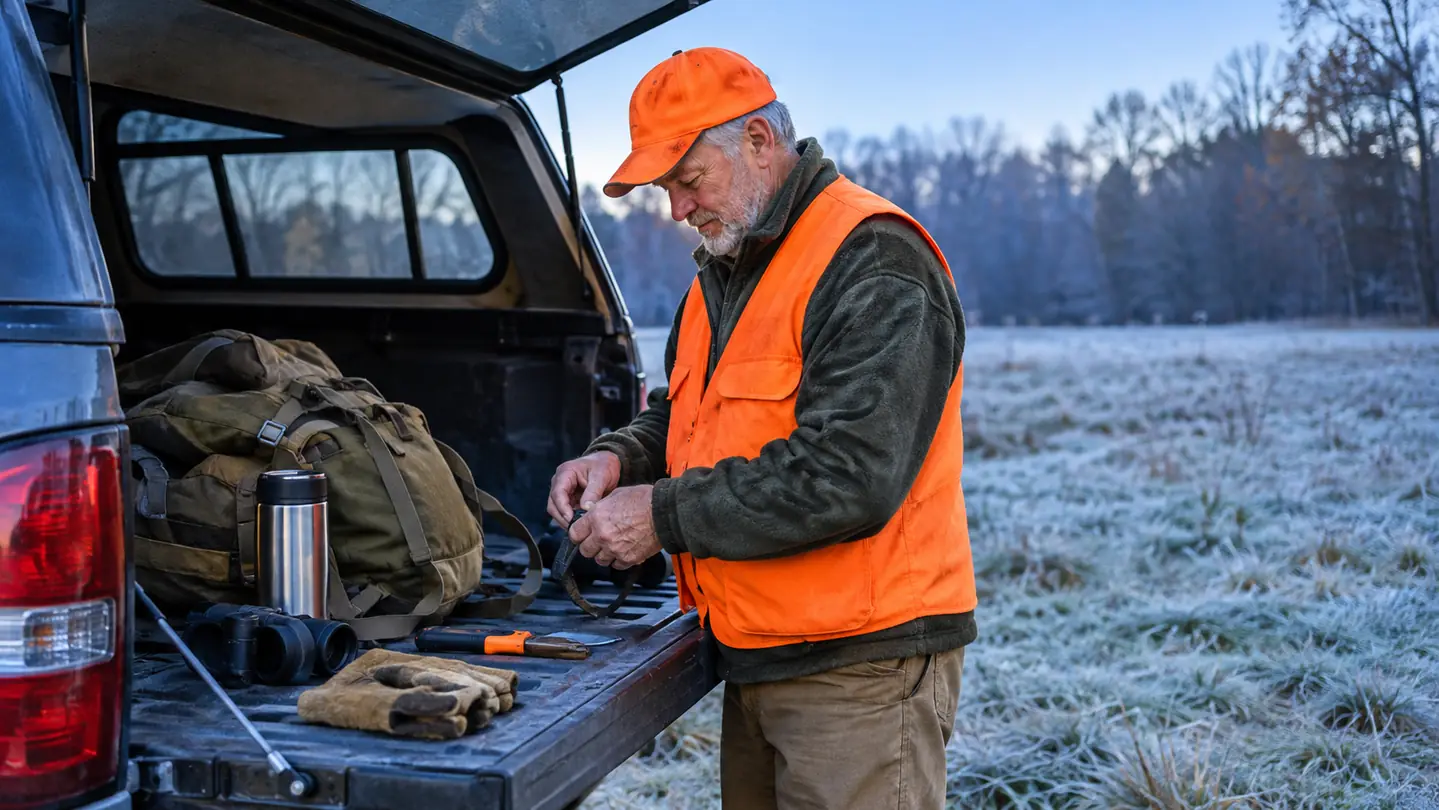
Opening morning two seasons back I field dressed a doe in the dark with the same folding knife I had carried since the nineties. By the time she was in the truck bed my right hand had quit closing all the way. Not the cold. The handle. A two inch grip is a fine thing in your pocket and a poor thing inside a deer, and it took me about forty seasons to say that out loud. The Mossy Oak Field Dressing Kit is what replaced that routine, and after three Pennsylvania deer seasons, a couple of spring turkeys, and a fair amount of shed work, I have opinions worth writing down.
I am Gideon Marchetti. I hunt whitetail on state game lands and on my late father's sixty acres outside Coudersport, and I have been carrying a rifle and a bow for close to forty years. My son-in-law Danny started hunting about six years ago and now does half the dragging, so this review comes from two sets of hands. One has opened a few hundred deer. The other was still learning where the blade goes. Neither of us tests gear for a living. We are two men who process our own animals in a shed with a woodstove and a garden hose.
The Quick Verdict
The saw and the boning knife carry this set. Three seasons in, nothing has failed, the case keeps eight pieces in one grab, and the only real complaint is that it is a truck item, not a pack item.
Amazon Check Today's Price →The blunt tip on that saw is worth the whole case
One tool built so it will not punch the bladder, one knife that follows a seam instead of wandering, and a case that keeps them together so nothing gets left in the shed.
Amazon Check Today's Price on Amazon →How I've Used It
The case lives in the bed of my 2011 Ford F-150 under the cap, next to a tote of latex gloves and a roll of paper towels. That is not a storage decision, it is a usage decision. When a deer goes down at last light, I open the tailgate, open the case, take the gut hook skinner, and leave the rest where it sits. I do not carry eight pieces into the woods. I carry one, and the set waits at the truck.
Where the whole set earns its place is the shed. Once the deer is hanging, everything comes out. The boning knife does the bulk of the work. The caping knife does the fine work if I am keeping a cape. The gut hook opens the belly. The saw goes through the pelvis and the brisket. I have done that enough times now that I do not think about which tool I am reaching for, and that is the sign a set is laid out right.
The handles are the part I did not expect to care about. Late November in Potter County, you are working with gloves on or you are working with numb hands, and most folding knives give you almost nothing to hold with a glove on. These have enough handle that a thin glove stays on for the whole job and I can still feel where the blade is going. That sounds like a small thing until you have tried to open a deer with a two inch handle and a wool mitt.
The one story worth telling is Danny's first solo gut job. He called me from the wood lot because he could not find the seam under the rib cage. I told him to stop cutting, switch to the gut hook, and keep his off hand out of the way. Twenty minutes later he had it done and he has not called me since. That is what a set like this does for a new hunter. It removes some of the guessing. Nothing in that case will teach you anatomy, but it gives you a tool shaped for each part of the job, and the shape is most of the lesson.
What I have not done is abuse it. I have not left it in the rain for a week or dropped it in a creek. What I have done is gut, skin, quarter, and cape somewhere around fifteen deer with it, disjoint a few turkeys, and do most of that work in cold weather. Cold is when a handle tells you the truth about itself.
What's Actually in the Case
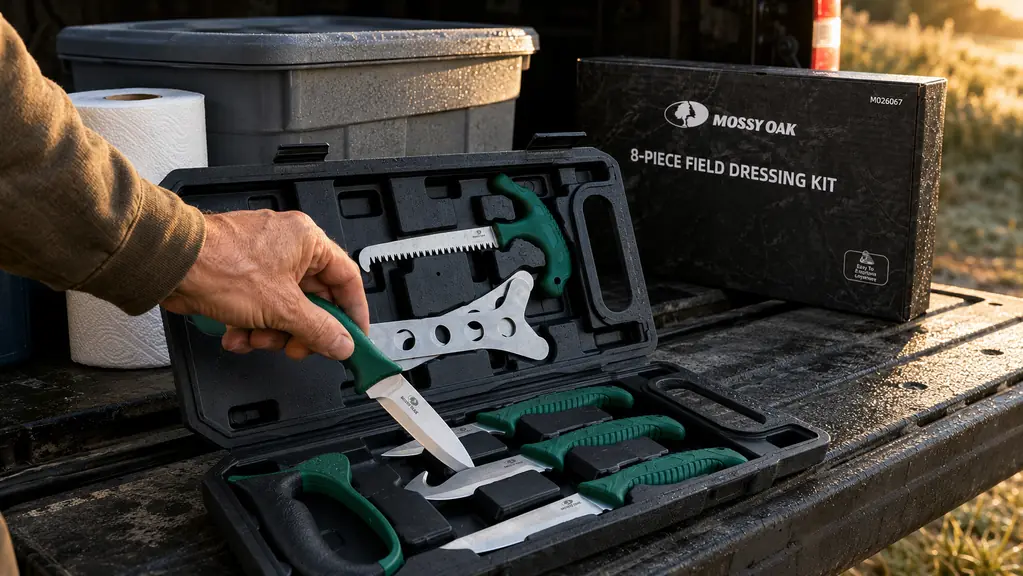
The Mossy Oak listing calls it an eight piece set and names a wood and bone saw, a steel stick that serves as a brisket spreader, a caping knife, a gut hook skinner, and a boning knife. Everything is stainless steel. The package measures about 16 by 8 by 2 and a half inches and runs a little over three pounds with the case included. The manufacturer warranty is one year.
The boning knife is the piece I would replace the whole set to keep. It is a 9.75 inch blade, long enough to run a backstrap in one pass, and it follows a seam between muscle groups instead of wandering off into the guts. Danny, who is six years in and was butchering his deer into three unrecognizable chunks, now produces actual cuts. That is the clearest thing I can tell you about a knife.
The gut hook skinner does the one job that ruins an animal if you get it wrong. You open the belly without opening the stomach. I have used gut hooks that grab fat and skip, and when that happens you are back to sawing at a belly with a blade, which is how a man ends up hosing out a body cavity at nine at night. This one has not skipped on me yet.
The caping knife does the fine work around the head and the ears if you are keeping a cape, and it is the piece that got me to stop using a paring knife for that job. Small blade, controlled cut, and it reaches the tight spots without me putting my whole hand inside the deer.
The steel stick and brisket spreader is the piece I use least and Danny uses most. Holding a chest open while you work is the difference between working and fumbling, and it does not take a complicated tool to do it. It is a stick. It does the job of a stick.
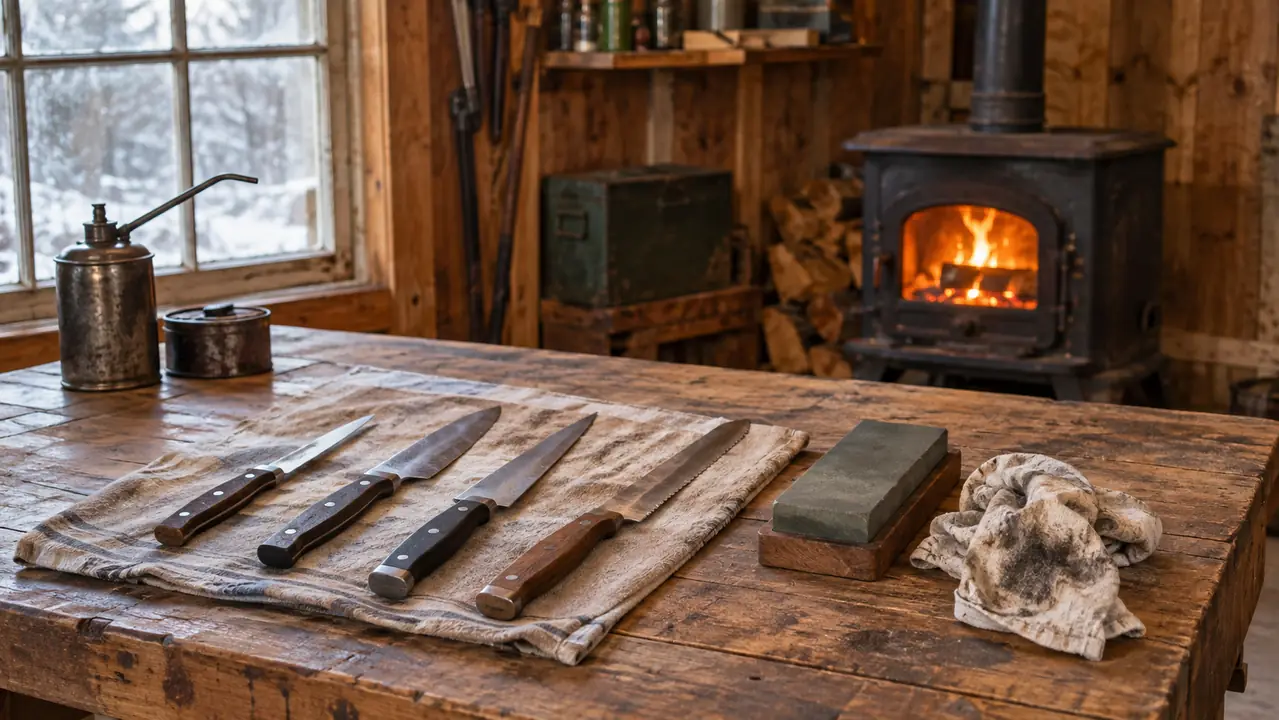
Everything comes from the factory with an edge that will cut, not an edge that will shave. I touched up the boning knife on a stone before the first season and I have done it once a year since, whether it needed it or not. Stainless will still spot if you put it away wet. Nothing has pitted on me. I wipe each piece with an oily rag before it goes back in the case, which is a habit, not a fault in the steel.
Three seasons, somewhere around fifteen deer, and the only piece I have had to touch up is the one I use hardest. Nothing has broken. Nothing has gone back in the case wet and come out ruined.
The Saw Is the Reason the Case Comes Home
If you only ever buy one piece of this set separately, buy the saw. It is a wood and bone saw with a blunt hooked tip on the end, and the whole point of that tip is that it will not punch through the bladder or the intestines while you are working around the pelvis. I have opened a deer with a hand saw pulled out of a truck toolbox because nothing better was along. I have opened one with a hatchet, once, and I would rather not go into it. A blunt tip is a small design decision that saves you a large cleanup.
The rest of the set is good. The saw is the part that changes how a job goes. That is why the case comes home with me instead of staying in the shed with the rest of the processing gear.
How It's Held Up Over Three Seasons
I would put the count at fifteen deer, maybe a couple more, plus turkeys. The saw blade has not dulled to the point I have noticed. The handles have not loosened. No joint has opened up. The gut hook still catches. The only thing I have maintained is the boning knife, and even that is more ritual than necessity at this point.
The set has also done spring turkeys, which is a smaller job that does not need most of the case. I take the caping knife for that and leave the rest in the truck. Grouse and squirrel get the same treatment. So the honest breakdown is that the deer work uses the whole set and everything else uses one or two pieces. That is fine by me. A man buys a set for the job that needs a set.
The case is the part that looks used, which is what a case is for. It has been sat on in the truck, rained on once, and had a quartered deer dropped on it. It still shuts and it still keeps the pieces apart from each other, which are the only two things I ask of a case.
The warranty is a year from the manufacturer. I have not had to use it, so I cannot tell you how that goes. What I can tell you is that nothing here has failed in a way that sent me looking for a backup in the middle of a job, and that is the standard I actually care about.
Where It Falls Short
It is not a pack item. Sixteen inches long, three pounds with the case, and it takes up more room than a man wants to give up in a day pack. If you are hunting backcountry and dressing an animal a mile in, this set stays in the truck and a fixed blade goes with you. That is not a flaw exactly. It is just what it is.
The caping knife is the piece that sees the least use from me. I cape one deer every few years, and the rest of the time it sits in its slot. Same with the spreader, honestly, on my end. Danny would argue with me about that. Two men, two answers, which tells you something about which pieces are essential and which ones are a matter of how you were taught.
There is no sharpener among the eight pieces. If you dull the boning knife halfway through a job you are done until you get back to a stone, so I keep a small sharpener in the truck console. That is a five minute fix to a complaint, but it is a real one if you are used to a kit that includes one.
And the edges out of the box are working edges, not finished edges. If you expect to skin a deer with a knife straight out of the box, you will be disappointed by nearly every set on the market, this one included. Ten minutes on a stone before the season is the difference between a set that works and a set that fights you all afternoon.
What I Liked
- The boning knife follows a seam cleanly and holds an edge through a whole deer
- The saw's blunt hooked tip keeps you out of the bladder while you work the pelvis
- Eight stainless pieces in one case, so nothing gets left behind in the shed
- Three seasons of use with no failures, no loose handles, and no pitting
- The gut hook skinner opens a belly without grabbing fat and skipping
- Handles are big enough to hold with a glove on in cold weather
Where It Falls Short
- Too long and too heavy for a day pack at about 16 inches and three pounds with the case
- Working edges out of the box, not finished ones
- The caping knife and spreader sit unused unless you cape your own deer
- No sharpener included, so a dull blade ends the job until you get back to a stone
- Stainless will spot if you put it away wet
What I'd Buy Instead, and When
If you want one knife and nothing else, buy one good fixed blade with a four inch blade and a handle that fills your palm, then pair it with a small folding saw. You will carry less and you will still do a deer with it. I know men who have done forty seasons that way. What you give up is the gut hook, the spreader, and the right tool for the pelvis. Whether that matters depends on how many deer you do a year and how much you dislike improvising.
I have also watched a partner use a replaceable blade knife that worked fine and never needs a stone. It is a legitimate answer and I will not argue with a man who likes one. I do not, because a blade that flexes inside a body cavity makes me nervous and I have had one fold on me. If that does not bother you, there is nothing wrong with going that route and skipping the case entirely.
Who This Is For
This is for the hunter who processes his own deer, or who wants to start. Somebody with a shed, a gambrel, and a hose, who shoots two or three deer a season and would rather not drive forty minutes to a processor. It is also a fair first set for a new hunter, because it puts every tool in his hands at once and lets him figure out which ones he actually reaches for. Danny learned on the Mossy Oak set. He was gutting his own deer by his second season with this case sitting on the tailgate next to him. And it suits a two man camp, where one man keeps the case in his truck all season and the other one borrows from it.
Who Should Skip It
If you hunt one weekend a year and drop your deer at a processor, you do not need eight pieces. A good fixed blade and a small saw cover what little you do in the field. If you are hunting deep country and dressing animals where they fall, the case is dead weight and you want one knife with a handle you trust. And if you already own a boning knife you like, buying a whole set to get at the saw is a backward way to shop. Buy the saw and be done with it.
Eight pieces, one case, three seasons of proof
The saw keeps you out of the bladder. The boning knife does the real work. The case means you stop hunting for the right tool with wet hands and a headlamp in your teeth.
Amazon Check Today's Price on Amazon →