
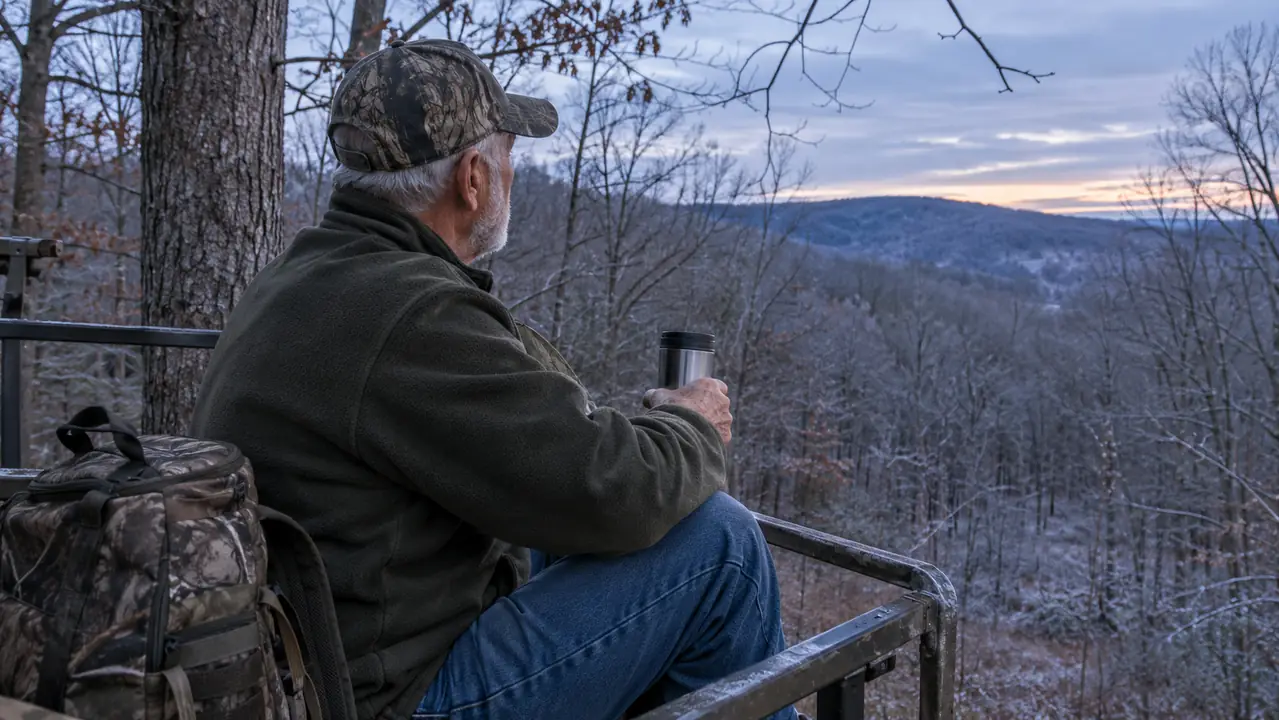
The first time I sprayed Scent Killer on my boots and watched a doe walk through at fifteen yards without breaking stride, I wanted to give the bottle all the credit. That was six seasons ago. Since then I have had mornings where the same spray did nothing I could measure, and mornings where it very likely kept a mature doe from winding me on the walk in. This is my honest accounting of which is which, because the label makes some claims that hold up and some that get repeated by people who have never tested them.
I am 58, retired from line work, and I hunt a 60 acre wood lot outside Coudersport that my father left me, plus a couple of state game land ridges when the pressure pushes me off. About 40 seasons of whitetail, archery in October and rifle in the rut, and spring turkey out of a ground blind. The product here is the Wildlife Research Center Super Charged Scent Killer Spray 48 oz combo, which is a 24 oz field bottle and a 24 oz refill. I have run through enough of it to have an opinion that is not based on the label.
The Quick Verdict
A narrow, real tool. It keeps working after it dries, which is more than most sprays can honestly say, and it buys margin on the walk in and the first hour on stand. It will not rescue a hunt where the wind is already wrong.
Amazon Check Today's Price →The bottle that lives in my truck bed, not on a shelf
The 24 oz field bottle rides behind the seat and the refill stays at camp, which is the whole reason I buy the combo instead of the single bottle. Nothing about that is exciting, and it is the reason I have not switched.
Amazon Check Today's Price on Amazon →How I've Used It, and How Much I Use
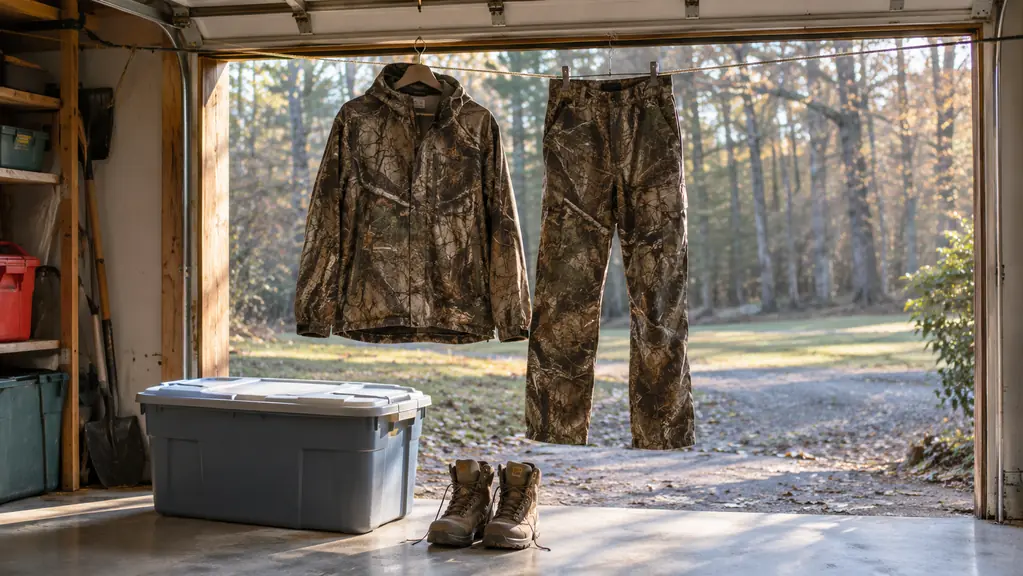
My routine has not changed much in six seasons. The night before, or the morning of if I am running late, I hang my outer layers on the porch and mist them: pants, jacket, base layer shirt if the weather is warm enough that I will sweat, gloves, face mask, pack straps, and the release. Then I leave them alone. That last part matters more than anything else on the list, and it is the part most people skip, because a damp jacket at 40 degrees is uncomfortable and a man will put it on anyway and then wonder why he is cold by 8 a.m.
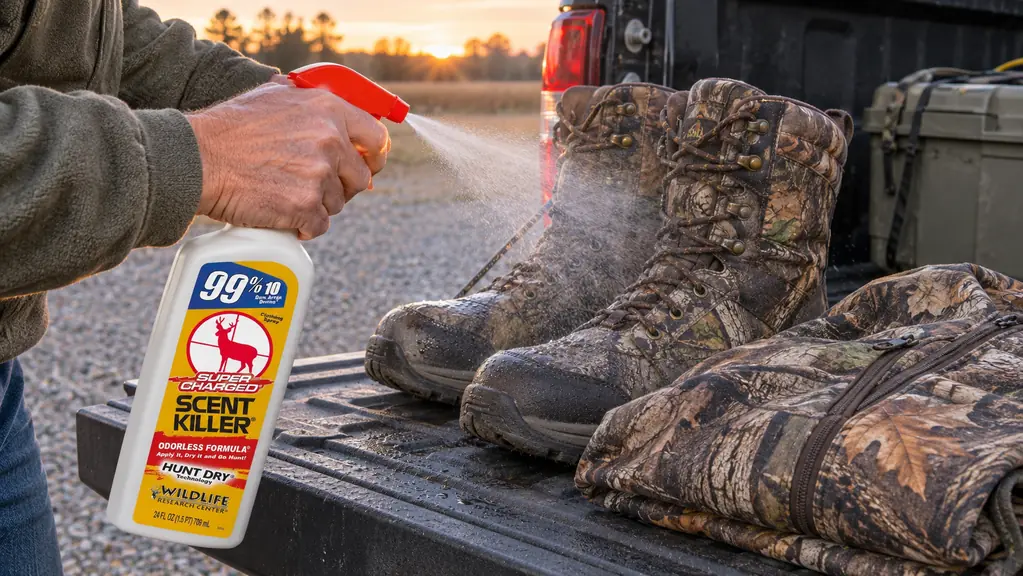
Boots get their own treatment, because boots are where a whitetail's nose goes first. I spray the outside, let them sit, then hit them again at the truck before I walk in. I do not soak them. A wet boot picks up every leaf and piece of chaff between the truck and the stand and then holds onto it for the rest of the morning, which is the opposite of what you were trying to accomplish.
A typical archery season for me is 30 to 40 sits. Misting five or six garments plus a pack and a pair of boots, light coats rather than soakings, the 24 oz field bottle gets me through most of October and into November before I am tilting it to get the last of it. The refill carries me through the rest of the season and into spring turkey. Your rate will be different if you are a soaker. Mine was too, at first.
There is a second, shorter version of the routine at the truck. Boots get a light pass, the pack gets a light pass, and the hat and gloves get a light pass, and then I stand there a couple of minutes and let the mist settle instead of climbing straight out. If it is below freezing, which it will be in late October in Potter County, the mist takes longer to dry and I am more careful about how much goes on. A jacket that crinkles when you move is not helping you.
What the Spray Actually Does
The bottle claims it destroys human odor at the molecular level. The second claim, the one that actually matters to me, is that it keeps working after it dries, which Wildlife calls Hunt-Dry Technology. I am not a chemist and I am not going to pretend I can verify the molecular part in my driveway with a flashlight. What I can tell you is that the dry-down behavior is real, and it is the reason I use this instead of a cover scent.
The number Wildlife puts on the label comes from testing at Rutgers University, where the formula was found to be 99 percent effective at stopping replicated human odor ten days after drying. Read that carefully. Replicated human odor, in a lab, on a test surface. That is a meaningful result and it is not the same thing as a three year old doe circling your stand in a crosswind. It tells you the chemistry is still active long after the water is gone, which is more than most sprays can honestly say. It does not tell you a deer cannot smell you, and any review that says otherwise is selling something.
Practically, it means I can treat gear the night before and not worry that it has quit by the time I climb. It means I can hit my pack straps at the truck and trust that they are still doing something at 9 a.m. after two hours of sitting still. That is a modest thing. It is also the difference between a spray I use and a spray I leave in the garage.
What It Does Not Do
It does not fix your breath. Nothing in a spray bottle touches the coffee and the toothpaste and the sandwich you ate on the drive in, and a deer that gets your breath at 20 yards is going to react no matter what your jacket smells like. It does not fix the sweat from a quarter mile climb up a ridge in 55 degree weather. It does not fix the ground scent of every step you took on the wrong side of the trail.
And it does nothing about wind. This is the part I wish someone had explained to me at the start. No spray, no detergent, no carbon suit makes a bad wind good. If the thermals are dumping your scent into the draw the deer are feeding out of, you can be the cleanest man in Potter County and you will still get picked off. The spray buys you margin. Margin is not immunity, and a man who confuses the two ends up blaming the bottle for his own mistakes.
Two seasons ago Danny and I were set up on the wood lot, him in the ladder stand and me on the ground about 40 yards downhill. I had treated everything that morning. The wind did what the forecast said it would do until about 8:30, and then it swapped for ten minutes, and a doe that had been working a scrape behind him got a nose full and blew out of the county. Nothing about that was the spray's fault. It was mine, for sitting in a spot that only worked on one wind.
Replicated human odor in a lab is a real result. It is not the same thing as a three year old doe circling your stand in a crosswind.
The Mistakes I Made With It Early On
The first bottle I bought, I soaked everything. My jacket was damp on the walk in, which is its own problem in October, and I went through a bottle and a half in three weeks. A light, even mist does the job. If the fabric is wet to the touch when you hang it, you used too much, and you also just spent three times what you needed to spend.
I also used to spray down inside the truck with the windows up. Do not do that. You will spend the next two days smelling it every time you get in, and the whole cab becomes the thing you were trying to eliminate. Spray outside, or in the garage with the door open, and let the gear hang until it is dry to the touch.
The other mistake was treating only what a deer could see. Base layer, hat, gloves, and the foam pad in the bottom of my pack all hold human scent. The pad was the one that got me. I could not figure out why does kept stopping on the trail short of my stand until I pulled that pad out one evening and it smelled like the inside of a gym bag. Now it gets misted with everything else and it hangs with the jacket.
The last mistake was timing. I used to treat my gear and then wear it around the house while I loaded the truck, ate breakfast, and topped off the thermos. By the time I reached the parking area the jacket had picked up the kitchen, the diesel, and the driveway. Now the treated gear goes straight into the tote and stays there until I dress at the truck. It sounds fussy. It is also the cheapest change I have made.
The 48 oz Combo, and Whether to Buy It That Way
Wildlife packages this as a 24 oz field bottle plus a 24 oz refill. That is the whole thing, no nozzle kit and no scent free bag. The field bottle has not clogged or sputtered on me, and I have left it in a cold truck bed overnight more than once without a problem the next morning.
Buying it this way means one bottle in the truck and one at camp, so I am not driving back to the house because I ran dry on a Saturday morning. It also means fewer orders and less chance of running out mid season. That is the entire argument for the combo, and for me it is enough. I wrote up the six season version of how the bottles themselves held up in a separate piece if that is the part you care about.
Store it out of the sun and out of the cab. I have thawed a bottle out after a cold snap and used it without noticing a difference, though I would not make a habit of it. What does seem to hurt it is heat. A bottle that lives on a dashboard all summer is not the same bottle in October, and I say that as a man who has tried it.
What I Liked
- Keeps working after it dries, which is the point of the whole thing
- A light mist goes a long way, so the 48 oz combo covers a full season for me
- No perfume or cover scent left behind on the gear
- The refill means I am not caught empty on a Saturday morning
- No staining or stiffness on wool, fleece or synthetics that I have noticed
Where It Falls Short
- Does nothing about wind, breath or sweat
- Easy to over apply, and a wet jacket is worse than a dry one
- The smell straight out of the bottle is more chemical than woods
- It is one piece of a routine, not a routine in a bottle
- The refill has no sprayer of its own, so the field bottle has to stay intact all season
The Ground Blind and Turkey Season
Spring turkey is a different problem, because a ground blind holds scent in a way a tree stand does not. I set the blind up a week before the season if I can and let it air out, then treat the inside fabric, the shooting sticks, and the stool. A tom coming to a decoy is looking for a hen, not for you, but he is not stupid either, and a blind that smells like a garage will get a reaction at 30 yards just as fast as a jacket will.
The other thing about the blind is that you are on the ground, which means ground scent matters more than it does from a stand. I treat the floor of the blind and the stool legs, and I keep my boots off the fabric when I can. None of that is in the instructions. It is just what six seasons of watching birds hang up at 40 yards taught me to try.
How It Fits With the Rest of My Scent Routine
The spray is one layer. The other layers are scent free detergent, a plastic tote, and a shower before I leave the house. I compared the spray against scent free detergent in a separate piece if you want the long version. The short version is that they do different jobs. Detergent gets the accumulated stuff out of the fabric in the wash. The spray handles what lands on the fabric between the dryer and the stand, which is a lot more than people think.
I have never used a carbon suit and I am not going to pretend to review one. I did use cover scents for years, earth and acorn and the like, and I stopped. A cover scent gives a deer something to work out. No scent at all gives it nothing to work out. That is the case for a killer over a cover, and it is the case that convinced me.
I keep the treated gear in a plastic tote in the bed of the truck under the cap, and the tote gets wiped out once a season. Mid season I re-treat the jacket and the pack even if they still smell like nothing to me, because my nose is not the one I am worried about. That is the whole system, and the spray is one line in it.
Who This Is For
This is for the hunter who already plays the wind and wants to shave the odds a little more on the walk in, on the gear staging, and in the first hour on stand. It suits the archery hunter who sits 30 or 40 times a season and the rifle hunter who wants a low effort routine that does not fall apart after a week. If you hang your gear outside, keep it in a tote, and want a spray you can apply the night before, this is the one I would hand you.
Who Should Skip It
Skip it if you are looking for something that covers a bad approach, a windy ridge, or a sweaty climb. It does not do that and no spray does. Skip it if you want a scent free system in a bottle, because this is one component and the tote and the detergent matter just as much. And skip it if you are the kind of hunter who sprays once in September and never again. This rewards a routine, not a purchase.
Buy it if you will actually use it before every sit
A 24 oz field bottle and a 24 oz refill, applied light and applied often, is what has kept this in my truck for six seasons. If your routine already looks like that, the combo is the sensible way to buy it. If it does not, no bottle will fix it.
Amazon Check Today's Price on Amazon →