
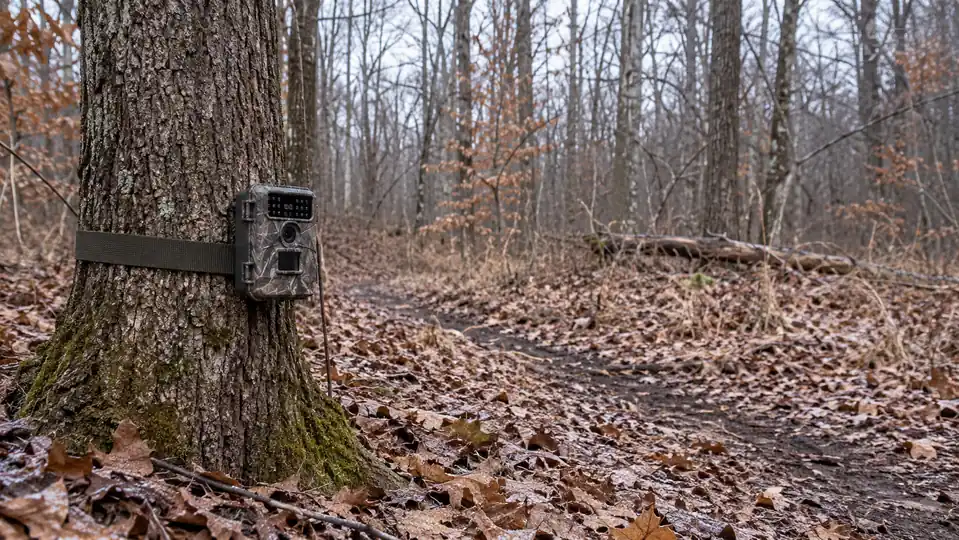
Short answer: for how I hunt, no. A cellular camera is a convenience, not a scouting advantage. It saves you the walk. It does not tell you anything a plain camera cannot tell you if you are willing to pull a card every couple of weeks.
I run the WOSPORTS Trail Camera on my late father's 60-acre wood lot outside Coudersport, and I have run a cellular unit on the same property for two seasons. Both take pictures of deer. Only one of them sends me a bill every month. Here is where each one actually earns its keep, and where the cellular camera is just an expensive way to look at the same oak flat I already know by heart.
| WOSPORTS Trail Camera | Cellular camera | |
|---|---|---|
| Monthly cost | Nothing. Batteries and an SD card | A data plan on top of the camera |
| Setup time | Strap it, set the date, walk away | Needs activation, a signal check and an app pairing before it works |
| Photo delivery | You pull the card and look at the pictures | Photos show up on your phone within a minute |
| Signal requirement | None. Works anywhere you can walk | Needs decent cell coverage at the camera. Deep valleys and ridge backsides are a real problem |
| Theft and damage exposure | Camera sits there. If it walks off, you lost the camera | Camera sits there. If it walks off, you may get a photo of the person taking it |
| Photo resolution | Up to 64MP stills and 4K video, adjustable down to 5MP | Typically lower-resolution images, because the file has to travel over a cell network |
| Night image quality | No-glow infrared, so it does not spook what walks past | Varies by model. Many compress night images hard to move them over the network |
| Field of view | 120 degree wide angle | Varies. Wide-angle is common but not universal |
| Battery life | Runs on batteries with no radio drawing on them | The radio is the biggest drain. Cold weather plus a weak signal can flatten a set fast |
| Checking in from out of state | You cannot. Somebody has to physically go | You can see what is moving while you are three hours away |
| Local preview | 2 inch color LCD right on the unit | Usually reviewed through a phone, though many have a screen too |
| Best for | The hunter who lives close and enjoys the walk | The hunter with a long drive and a camera on ground he cannot reach weekly |
Where the WOSPORTS Camera Wins
Start with the thing that never shows up in a spec sheet: nothing about this camera depends on a tower being in line of sight. My wood lot has a hollow running through the middle of it that eats cell signal like a sponge. The cellular camera I tried there sent me three photos in nine days and then went silent. I walked in expecting a dead battery and found it at 80 percent. It had signal enough to connect and not enough to send.
The WOSPORTS does not care. It has no compatible devices, no app, no pairing, no activation. It runs on batteries, straps to a tree, and records to an SD card. The listing gives you 64MP stills, adjustable down to 5, 16, 36, 48 or 56, plus 4K video. It gives you a 120 degree wide detection angle and a 0.2 second trigger. And it gives you a 2 inch color LCD so you can stand there in the cold and thumb through the last two weeks without hauling the card home first. Weight is 0.55 kg. It is waterproof, which around here means it survives a wet October and a January thaw, and it is rated to 8 volts on battery power.
The no-glow infrared matters more than people give it credit for. A camera that glows red at night is a camera that educates every buck that walks past it. No-glow means the flash is invisible to them. I have run this unit over scrapes where a mature buck worked the same licking branch for three weeks and never once looked at the tree. That is the whole game right there, and it is not a feature you can buy back with a subscription.
For what it is worth, here is exactly how mine has gone. I hung it on a white oak on the west edge of the lot on August 12, chest high, angled down a trail that runs from a bedding thicket out to a standing cornfield. Then I left it alone for nineteen days. When I pulled the card on the last morning of the month there were 340 pictures on it: does and fawns in a loose bunch every evening between 6:40 and 7:20, one scrappy six point, and a heavy-bodied buck I had never seen on that ground before, working a scrape eleven minutes past seven in full daylight. That is the answer to a scouting question, and it did not cost me a monthly fee to get it.
My short verdict: the WOSPORTS is the camera that works in the hollow, costs nothing monthly, and tells you what a mature buck is doing without teaching him you are watching.
Skip the monthly bill and the dead zone. See what this camera costs today.
Non-cellular, non-WiFi, 64MP stills, 4K video, no-glow infrared and a 2 inch LCD for checking right at the tree. No plan, no activation, no signal to hunt for.
Amazon Check Today's Price on Amazon →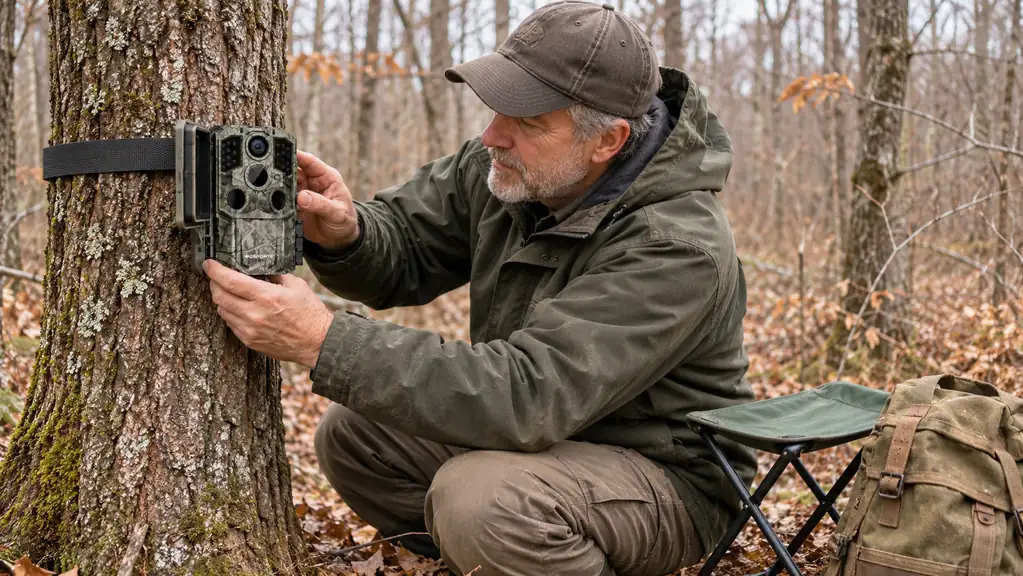
Where a Cellular Camera Wins
I am not going to pretend the cellular camera is a gimmick, because it is not. Two seasons ago my son-in-law Danny had a camera on a ridge three hours from his house. He got a picture of a shooter buck working a scrape at 4:40 in the afternoon on a Tuesday. He took Friday off and killed that deer. Nobody drove three hours to pull a card and made that happen. The camera told him, and he acted on it. That is a real advantage and it is the entire reason those units sell.
The way he runs it makes the case better than any argument I can make. His camera sits above a spring seep about a hundred yards inside the treeline, and he set it up on a Thursday evening in late October with a fresh set of batteries and a card he had formatted at the kitchen table. By Saturday morning he had forty-one photos on his phone. Nine point working the seep at first light both mornings, a doe group filtering through around nine, and a porcupine that apparently owns the place. He did not drive up. He sat at his own table and made a plan for the following weekend, and the plan was right.
The second place it wins is theft and trespass. A cellular camera emails you a photo of whoever is carrying it off. It will not get your camera back, but it will get you a face and a timestamp and something to hand the game commission. I have never had a camera stolen off the wood lot, but I have had a ladder stand messed with, and I would have liked a picture of that.
The third win is simple human laziness, mine included. A camera that texts you is a camera you check. A camera you have to walk to is a camera you check when you get around to it. In September that is fine. In the middle of rifle season, when you are tired and the light is short, the card pull is the first thing that gets skipped. If the value of your scouting is mostly about how often you actually look at the pictures, cellular wins on behavior alone.
A cellular camera does not tell you anything a plain camera cannot. It just tells you sooner, and only if a tower can hear it.
The Cost Nobody Adds Up
Here is where I get sour about the whole category. A cellular camera is not one purchase, it is a purchase plus a subscription for as long as you own it. Add it up over five seasons across a handful of cameras and you are into real money, money that could have been a better bow sight, a set of tires, or a second camera on ground you have never scouted.
And the plan is only half of it. Cellular units burn batteries faster because the radio runs constantly hunting for signal. Weak signal is worse than no signal, because the camera keeps trying. I have watched a cellular unit go from fresh batteries to dead in three weeks on a ridge where coverage flickered. The WOSPORTS has no radio, so its batteries go to the flash and the sensor and nothing else. Same cold, same tree, and one of them is still taking pictures in February.
I keep four cameras going on the wood lot. Two on field edges, one on a saddle between two ridges, one on a scrape line I have been watching since my father owned the place. I put fresh batteries in all four in the first week of September and I do not touch them again until the middle of November, and most years that first set carries them into February. That is four cameras and one set of batteries apiece, not four cameras and four monthly plans. When you are running more than one or two, that gap stops being an opinion and starts being arithmetic.
There is also the resolution tradeoff nobody mentions at the counter. A 64MP file is a big file. Cellular cameras compress images to move them, and what lands on your phone is not what the sensor captured. For counting points and judging age structure, a compressed thumbnail is workable. For deciding whether a buck is a 3 year old or a 4 year old at 40 yards, I want the full file off the card. The WOSPORTS gives me 5, 16, 36, 48, 56 or 64MP and lets me pick, and the 2 inch LCD lets me check right there before I commit a spot.
What 40 Seasons Taught Me About Scouting
I started running cameras late, maybe 15 seasons ago, and I made every mistake. I put them too high. I put them facing east so the morning sun blew out every picture. I checked them too often and laid my scent all over the exact ground I was trying to hunt. None of that has anything to do with whether a camera has a data plan.
I hung cameras at eight feet for two straight seasons believing higher was safer and harder to mess with. What I got was the tops of deer heads and a whole lot of sky, plus a set of pictures I could not judge a single rack from. I hung one on a field edge facing east and came back to thirty frames of pure white where the sunrise had eaten the sensor alive. And more than once I walked in on a Wednesday afternoon to swap a card in a spot I intended to hunt that Saturday, which is about the dumbest thing a man can do with a camera and I knew better when I did it.
What I have learned is that a camera is a tool for answering a narrow question: what is using this ground, and when. A plain camera answers it. A camera with a data plan answers it faster. Neither one answers it if you mount it wrong, check it too much, or hang it on a tree the deer walk past at 60 yards. The camera is the smallest part of the equation and the part people argue about the most.
If you want the long version of how this particular unit has held up, I wrote it up separately. The short version is that mine has been out through two winters, one of them hard, and the only failure was a set of cheap batteries in January.
Who Should Buy Which
Buy the WOSPORTS if you live within reasonable driving distance of your ground and you actually get out there. Buy it if your property sits in a valley, behind a ridge, or anywhere your phone drops to one bar. Buy it if you have more than two or three cameras to run, because the monthly math multiplies and the card pull is the same walk either way. Buy it if you want the full-resolution file to judge a buck's age instead of a compressed version on a screen. And buy it if you just want a camera that works and does not ask you to manage an account.
Buy a cellular camera if your ground is hours away and you can only get there a few times a season. Buy it if the property is pressured or you have trespass concerns and want a photo of whoever is walking it. Buy it if you are the kind of hunter who checks a phone fifty times a day anyway, because you will use it and the value is real. Danny's setup makes sense for Danny. Three hours is three hours.
The mistake is buying cellular because it sounds like the upgrade. It is not an upgrade. It is a different tool with a subscription attached, and it only pays you back if the distance or the security actually applies to your situation. Most of us hunt ground we can reach on a Saturday morning. For that hunter, the plain camera is not the budget option. It is the right option.
You can reach your ground on a Saturday. Buy the camera that does not need a tower.
WOSPORTS Trail Camera: 64MP stills, 4K video, 0.2 second trigger, 120 degree detection, no-glow infrared, waterproof, 2 inch color LCD. No plan. No signal. No account.
Amazon Check Today's Price on Amazon →What I Liked
- Works with no cell coverage at all, including deep hollows and ridge backsides
- No monthly plan, activation or account to manage
- Up to 64MP stills and 4K video, adjustable resolution down to 5MP
- No-glow infrared does not educate deer the way a red glow does
- 2 inch color LCD lets you preview on the tree without pulling the card
- 120 degree wide detection angle with a 0.2 second trigger
- Waterproof, 0.55 kg, runs on battery power
Where It Falls Short
- You have to physically walk to it to see anything
- No phone alerts, so a trespasser is not caught in the act
- Card management is on you, and cards do eventually fail
- It runs on battery power, and cheap batteries will let you down in January
A Note on How I Run Either One
Whichever you hang, mount it chest high on a tree with a clear lane, angle it slightly down the trail rather than across it, and keep it out of the direct morning sun. Set the date and time before you walk away, because a card full of undated pictures is a card full of guesses. Wear gloves when you handle it. Check it at midday, not at dawn on the way to the stand, and not the day before you plan to hunt that spot.
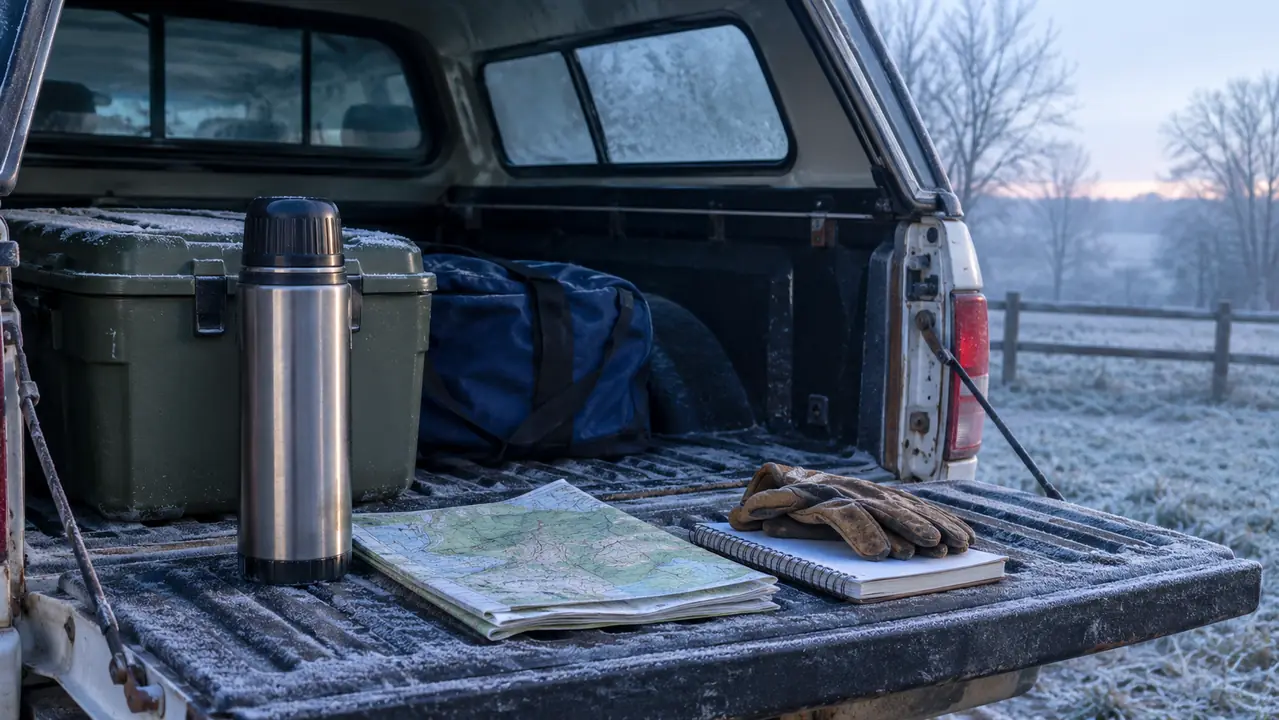
And write it down. I keep a spiral notebook in the truck and I log the date, the spot and what was on the card. Two seasons of that tells you more about a buck's pattern than any subscription will, because a camera shows you a moment and a notebook shows you the season.