
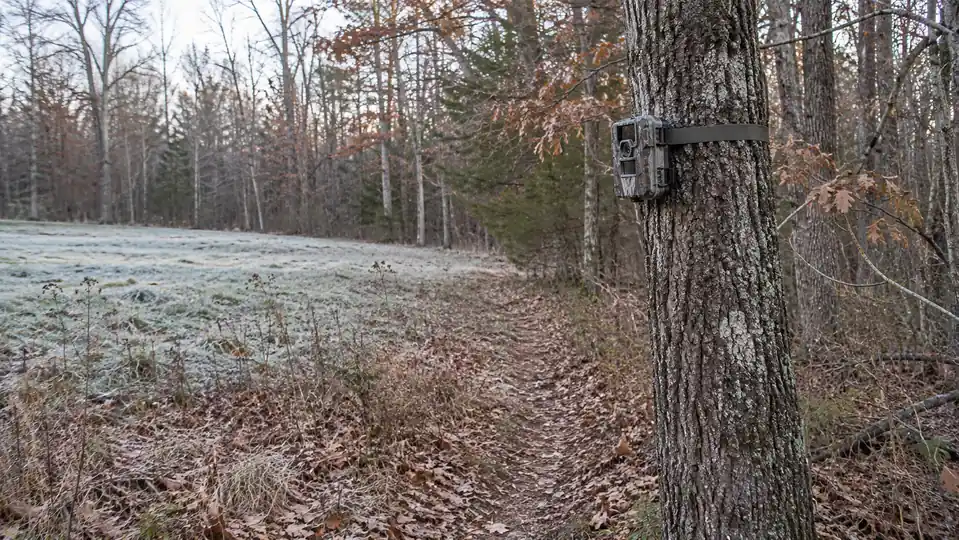
I have had the WOSPORTS trail camera hanging over a scrape line on the north edge of my wood lot since the first week of August, and I want to start with the part the product page leaves out. The first two weeks of pictures were mostly of me, one swaying beech limb, and a raccoon that came back eleven nights running. That is not a knock on the camera. That is what happens when you strap a box to a tree at chest height, point it east, and walk away without a second thought.
So here is the honest version. I am 58, retired out of line work, and I have been chasing whitetail around Potter County for about 40 seasons. I am not a gadget man. My son-in-law Danny, who has been at this six years now, is the one who keeps pushing new gear at me. He handed me a WOSPORTS camera and told me to run it a full season before I made up my mind. This is what I found, including the parts that aggravated me.
The Quick Verdict
A genuinely useful scouting camera for a man who wants pictures and not a subscription. Good daylight detail, better night work than I expected, and a setup that punishes anybody in a hurry.
Amazon Check Today's Price →The camera I left on a tree for four months and never had to go rescue
No cellular plan, no app, no account. Batteries and a card go in, pictures come out, and the screen on the front tells you what you got before you walk back to the truck.
Amazon Check Today's Price on Amazon →How I Actually Run It
One camera, one tree, one season. I hung it on a white oak about ten feet off the scrape line, roughly eight feet up, angled down maybe fifteen degrees. Higher than the instructions probably suggest, lower than a lot of fellows run theirs. What I wanted was a look at a deer's shoulder and head, not the top of his back. The mount is the strap-and-bracket sort, and the housing is a box, so it sits flat against the trunk with a little shimming from a wedge of bark.
Before any of that, though, I made the mistake most people make. I strapped it to a red maple at chest height on the 12th of August, facing east because that was the side of the tree facing the scrape, and left it alone for eleven days. I came back to 340 pictures: about 290 of that beech limb, 40 of me walking in and out, and 10 of the back half of a doe leaving the frame. Chest height puts the lens under a deer's nose line and the low angle throws the whole frame at the ground. Eight feet fixed it in one afternoon.
Past that one tree I moved it twice. Once to the fence line where the wood lot meets the hayfield, because the does were crossing there every evening through late September. Once to a maple near the ground blind I carry for turkey, mostly to see whether the thing would spook anything at close range. It did not. Two hens walked past it at six feet and never gave it a look.
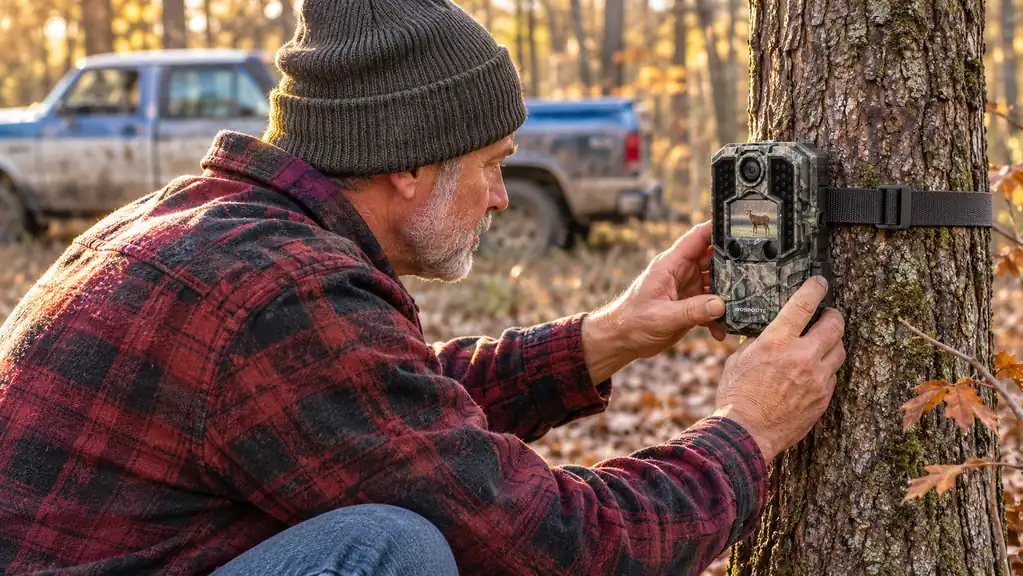
What that means for you is this: it is a camera you put out and leave out. It runs on batteries, so there is no cord and no solar panel to fuss with. There is a 2 inch color LCD on the front, which means you can pull the card, look at what is on it, and decide whether to move the camera before you hike back to the truck. I did not properly appreciate that until I owned a camera that made me drive home to learn I had twelve pictures of a squirrel.
Everything below comes from roughly 4,300 pictures and a few dozen short video clips off that one unit. Not lab numbers. Just a camera on a tree in Potter County in weather that went from 88 degrees in August to 14 in December.
The 0.2 Second Trigger Is Real, and It Is Not Your Bottleneck
The listing says 0.2 second trigger, motion activated. I believe it. What I do not believe is that trigger speed is what costs most people their best pictures.
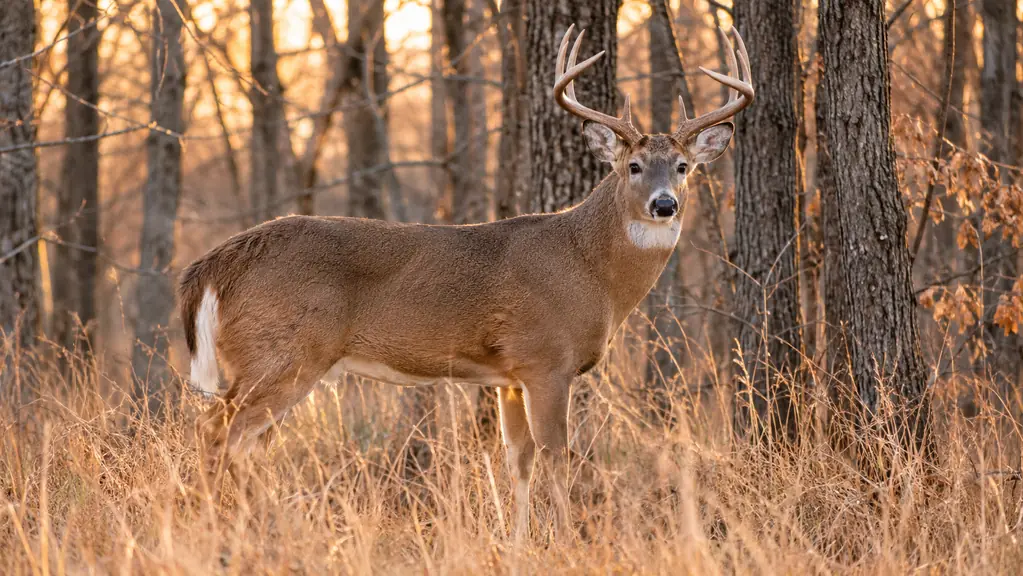
Here is what I mean. Late October I had a decent eight point come through that scrape at last light, walking. He was in frame maybe three seconds. I got four pictures in burst mode and all four were usable. The camera did its job. What nearly cost me was the card I had in it, an old one dug out of a kitchen drawer, which wrote slow enough that the next burst came late. Swap in a fast card and the problem goes away. That is not a camera flaw. That is me being cheap.
The other thing is that detection matters more than trigger. The camera lists a 120 degree wide detection angle. That is wide, and wide cuts both directions. It caught deer entering from the side that a narrower camera would have missed entirely. It also caught a great many branches and one memorable sequence of a falling leaf. Point it at a lane, not at a thicket, and the wide angle earns its keep.
The 1 to 3 burst setting is where I landed. Three frames, small gap between them. Enough to catch a deer's head coming up out of the scrape, not so many that you burn card space on a swaying limb. I tried all three options before I settled. Two frames missed the head lift on a buck that came in behind a doe. Three caught it. When I pushed it to the top, I got six pictures of the same deer taking two steps and chewed through a 32 GB card in nine days. Three is what it has been set on since the first week of October, and I have not had a sequence yet where I wished I had more.
One more honest note on pictures. The camera will shoot 64 megapixels, and it will also shoot 5, 16, 36, 48 or 56. I ran it wide open for the first three weeks because bigger sounded better. It is not better. It is bigger. A 16MP picture of a deer at 25 feet carries every bit as much information as a 64MP picture of the same deer, and it writes faster and eats less card. Save the high setting for a camera covering a field edge where you might want to crop hard on a buck at 80 yards.
Night Work: Better Than I Expected, With One Condition
The camera uses no-glow infrared for night vision. No-glow means what it sounds like. It does not throw the red glow older cameras did, the one that makes some deer stop and stare up into the tree and get edgy. I ran it beside an older red-glow unit for two weeks in September and the difference was plain. Deer walked past the WOSPORTS without a pause. They stopped and looked at the old one twice.
Here is the night that settled it for me. The 2nd of November, 24 degrees, heavy frost on the grass. I had a ten point on camera at 6:41 in the evening, which was past legal light, so I was not hunting him that day, only watching. He stood at that scrape close to four minutes. Nineteen frames came off the card. Thirteen of them were clean enough to count tines and see he carried a split G2 on the left side. The camera did that in the dark with nothing going off in his face.
Picture quality after dark is grainy the way all infrared is grainy, black and white, and it falls off fast past about 40 feet. Inside 30 feet it is good enough to count points and judge a body. I would not try to age a buck off a night picture from this camera. I would absolutely use it to decide whether a particular buck is worth a cold morning in the ladder stand.
The condition is this: keep the lens and the infrared panel clean, and keep the camera out of tall grass. I had a stretch in late summer where the grass grew up into the bottom third of the frame, and every night picture for a week was a white blur where that grass caught the infrared and threw it straight back. That is not the camera failing. That is me not walking out with a weed whip.
Setup Tips, Learned the Hard Way
Point it north or south. My first placement faced east and I got two weeks of blown-out sunrise pictures and lens flare. Facing north or south keeps the sun out of the frame for most of the day. This is the biggest single thing you can do and it costs nothing but a compass.
Hang it higher than feels right and angle it down. Eight feet up, tipped down, puts the camera above a deer's line of sight and gives you a better look at body and head. It also keeps the unit out of reach of a bear that decides to investigate, which matters more than people admit around here.
Clear the ground in front. Not a manicure, just knock down what is going to grow into the frame by October. Infrared bouncing off grass is the number one cause of bad night pictures on any camera in this class, and it is entirely a you problem.
Format the card in the camera, not on your laptop. I have had exactly one card go unreadable in 40 seasons and it was one I formatted on a computer.
Test it before you leave. Wave a hand in front of it, walk back to the truck, come back in ten minutes, check the screen. Five minutes of your morning saves a two week round trip.
Where It Misses
No cellular, no WiFi. That is in the product title, so nobody should be surprised, but it deserves saying plainly. You walk out and you pull the card. If your hunting ground is two hours from your kitchen, that is a real cost, and you should be shopping cellular instead. There is a separate write-up on how this one stacks up against the cellular units if that is the decision in front of you.
Battery life is entirely on you. It runs on batteries, and a cold Pennsylvania November is hard on any battery ever made. I keep a written note in the truck on change-outs, mostly because I got tired of guessing. First set went in on the 14th of August, alkaline, and came out on the 22nd of September still showing two bars. Second set, same alkalines, went in the 22nd and was flat on the 14th of November. That is roughly three weeks and change once the overnight lows got into the teens. The lithium set I ran in December lasted right up until I pulled the camera on the 9th.
The 0.2 second trigger and the 120 degree detection are both real, and both are quoted under good conditions. In real cold, with a card that is nearly full, everything slows down a step. Do not expect July behavior in January.
The housing is a box, waterproof, and it came through a wet fall with nothing inside it. It is not armored. A bear that decides to chew on it will win, and I do not hold that against a camera at this level. It weighs 0.55 kg, light enough to strap to a trunk one handed in the dark, which I appreciated more than I expected after years of heavier units.
What I Liked
- Sharp daylight pictures, and the 64MP setting earns its place when you need to crop on a deer at distance
- No-glow infrared does not put deer on edge the way older red-glow cameras do
- The 2 inch color LCD lets you preview and delete right at the tree
- 120 degree wide detection catches deer entering from the side
- Simple setup, waterproof housing, light enough to hang one handed in the dark
Where It Falls Short
- No cellular and no WiFi, so every card pull is a drive and a walk
- Heavy battery drain once the weather turns cold
- 64MP files are large and write slow on a cheap card
- Night range falls off hard past about 40 feet
- No armor. A determined bear ends the conversation
Deer walked past the WOSPORTS camera without a pause. They stopped and looked at the older red-glow unit twice. That difference is worth more than any number printed on the box.
Who This Is For
You hunt a piece of ground you can get to on a Saturday morning without planning a trip. You want to know what is walking it, when, and whether the buck you saw in September is still around in November. You do not want a data plan, a monthly bill, or a phone app that has to be updated before it will talk to your camera. That is the man this camera was built for, and it does that job without drama.
It also suits a fellow who hunts several spots and wants to move a camera around without reconfiguring anything. The screen on the front means you can check a set in the dark with a headlamp and be walking again in two minutes. I moved mine three times this season and never once wished I had a laptop with me. Danny runs a camera on the other side of the wood lot and we compare notes out of the truck bed most Sundays, and neither of us has had to go fetch this one out of a swamp.
And it suits the hunter who wants a second or third camera without spending like it is the only one he will ever own. Put the good money into one place and let the WOSPORTS cover the travel corridors and the fence crossings.
Who Should Skip It
If your ground is far from home, skip it. A camera with no cellular and no WiFi is a camera you have to physically visit, and if that visit costs you four hours of driving, the money you saved on the unit disappears into the fuel tank by the second card pull. Be honest with yourself about the drive before you buy.
If you want pictures pushed to your phone at noon while you are at work, skip it. That is a different product and this one will not pretend otherwise.
And if you are the sort who will hang it in August, never clear the grass, never format the card, and then blame the camera when the night pictures look like fog, skip it. This unit rewards about fifteen minutes of setup sense. It does not reward a fella who throws it at a tree and drives off, and honestly no camera does.
One last thing I would tell a friend. Buy the card before the camera arrives. Buy two. A camera sitting in the truck because you did not have a card in the drawer is a camera doing nothing, and the season does not wait around while you make a run to town.
Four months on one tree, no rescues, no subscription, no surprises
The honest summary: good daylight detail, no-glow night work that does not spook deer, a screen you can read at the tree, and none of the monthly cost. If that matches how you hunt, it is worth a look at today's price.
Amazon Check Today's Price on Amazon →